Potassium Carbonate → 2-(4-(3,5-Bis(hydroxymethyl)phenoxy)butyl)isoindoline-1,3-dione
Reaction equation

[OH:1][C:2]1[CH:3]=[C:4]([CH2:10][OH:11])[CH:5]=[C:6]([CH2:8][OH:9])[CH:7]=1.Br[CH2:13][CH2:14][CH2:15][CH2:16][N:17]1[C:25](=[O:26])[C:24]2[C:19](=[CH:20][CH:21]=[CH:22][CH:23]=2)[C:18]1=[O:27].C(=O)([O-])[O-].[K+].[K+]>C(#N)C>[OH:9][CH2:8][C:6]1[CH:7]=[C:2]([CH:3]=[C:4]([CH2:10][OH:11])[CH:5]=1)[O:1][CH2:13][CH2:14][CH2:15][CH2:16][N:17]1[C:25](=[O:26])[C:24]2[C:19](=[CH:20][CH:21]=[CH:22][CH:23]=2)[C:18]1=[O:27]Participants
5

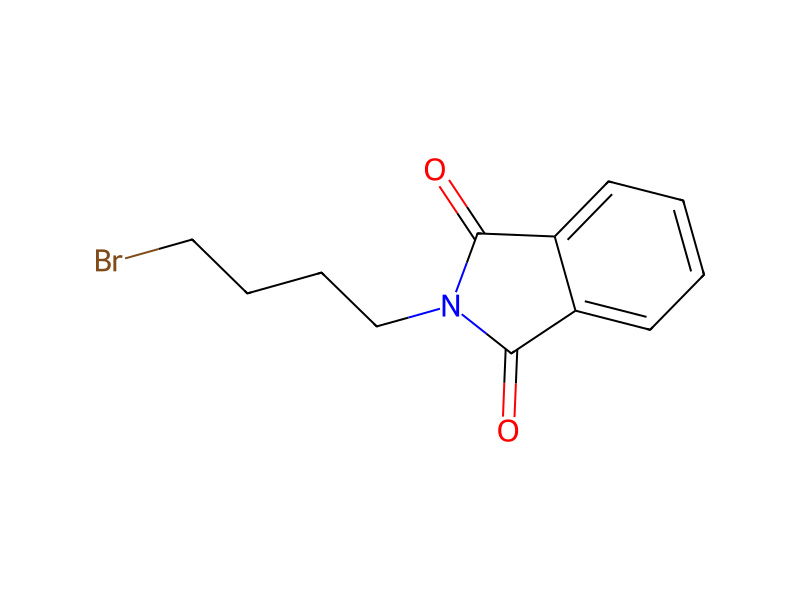



Procedure
To a stirred solution of (5-hydroxy-1,3-phenylene)dimethanol (7.27 g, 47 mmol, 1 eq.) in 200 mL of acetonitrile at room temperature, 2-(4-bromobutyl)isoindoline-1,3-dione (1.2 eq.) and potassium carbonate (K2CO3, 2 eq.) were slowly added. The resultant mixture was then heated at reflux for 8 hours, after which the volatiles were removed, and the residue was partitioned between EtOAc and water. The EtOAc layer was washed with brine and dried over MgSO4. Evaporation of EtOAc gave 2-(4-(3,5-bis(hydroxymethyl)phenoxy)butyl)isoindoline-1,3-dione (13 g, 78% yield).
Workup
- temperatureat reflux for 8 hours
- customafter which the volatiles were removed
- customthe residue was partitioned between EtOAc and water
- washThe EtOAc layer was washed with brine
- dry with materialdried over MgSO4
- customEvaporation of EtOAc
Sources & evidence
- ORD record
- ord-485553b693eb47b0b186cba689c5fbd3
- Source dataset
- uspto-grants-2016_07
- Patent number
- US09388193B2
Reaction notes
Loading…