Cesium carbonate → (E)-4-(2-(2,4-Dichlorophenyl)-1-(1-(tetrahydro-2H-pyran-2-yl)-1H-indazol-5-yl)but-1-en-1-yl)benzaldehyde
Reaction equation

[C:1]([C:5]1[CH:6]=[C:7]2[C:11](=[CH:12][CH:13]=1)[N:10]([CH:14]1[CH2:19][CH2:18][CH2:17][CH2:16][O:15]1)[N:9]=[CH:8]2)#[C:2][CH2:3][CH3:4].B1(B2OC(C)(C)C(C)(C)O2)OC(C)(C)C(C)(C)O1.I[C:39]1[CH:46]=[CH:45][C:42]([CH:43]=[O:44])=[CH:41][CH:40]=1.C(=O)([O-])[O-].[Cs+].[Cs+].[Cl:53][C:54]1[CH:59]=[C:58]([Cl:60])[CH:57]=[CH:56][C:55]=1I.[OH-].[K+]>C1C=CC([P]([Pt]([P](C2C=CC=CC=2)(C2C=CC=CC=2)C2C=CC=CC=2)([P](C2C=CC=CC=2)(C2C=CC=CC=2)C2C=CC=CC=2)[P](C2C=CC=CC=2)(C2C=CC=CC=2)C2C=CC=CC=2)(C2C=CC=CC=2)C2C=CC=CC=2)=CC=1.O1CCOCC1>[Cl:53][C:54]1[CH:59]=[C:58]([Cl:60])[CH:57]=[CH:56][C:55]=1/[C:2](/[CH2:3][CH3:4])=[C:1](\[C:39]1[CH:46]=[CH:45][C:42]([CH:43]=[O:44])=[CH:41][CH:40]=1)/[C:5]1[CH:6]=[C:7]2[C:11](=[CH:12][CH:13]=1)[N:10]([CH:14]1[CH2:19][CH2:18][CH2:17][CH2:16][O:15]1)[N:9]=[CH:8]2Participants
Reactant 6





Product 1

Reagents, catalysts & solvents 2


Procedure
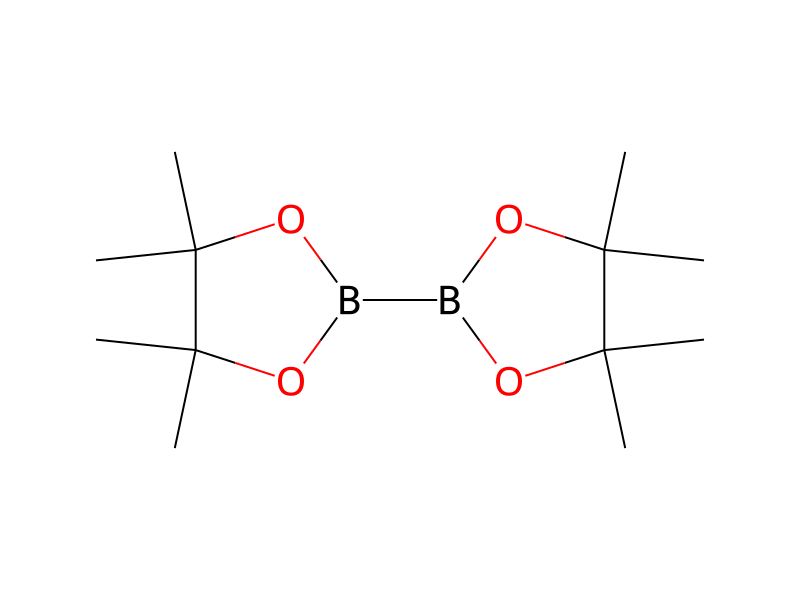
A round-bottom flask equipped with a magnetic stir bar, a reflux condenser, and a N2 inlet was charged with 5-(but-1-yn-1-yl)-1-(tetrahydro-2H-pyran-2-yl)-1H-indazole (20.0 g, 78.6 mmol; Intermediate 3), bis(pinacolato)diboron (20.17 g, 79.4 mmol), tetrakis(triphenylphosphine)platinum (0) (0.98 g, 0.8 mmol), and anhydrous 1,4-dioxane (160 mL). This mixture was degassed with three vacuum/N2 cycles and refluxed for 4 h. The solution was then allowed to cool to room temperature, and 4-iodobenzaldehyde (18.25 g, 78.6 mmol), trans-dichloro(triphenylphosphine)palladium (II) (5.52 g, 7.9 mmol), cesium carbonate (51.24 g, 157.3 mmol), and 1,4-dioxane (160 mL) were added. This mixture was degassed with three vacuum/N2 cycles, and then water (4.7 mL) was added. This mixture was stirred at room temperature for 6 h. 2,4-Dichloroiodobenzene (12.8 mL, 94.4 mmol) and 6M aqueous KOH (62.9 mL) were added, and the mixture was degassed with three vacuum/N2 cycles and refluxed for 4 h. Upon completion, the reaction mixture was filtered through a Celite/silica pad and washed with EtOAc. The filtrate was washed with water (600 mL), washed with brine (300 mL), dried over sodium sulfate, filtered, and concentrated. The crude product was purified by silica gel chromatography (0-20% ethyl acetate in hexanes) to give the title compound (27.2 g, 7:1 mixture of regioisomers) as a yellow foam. Data for major regioisomer: 1H NMR (400 MHz, DMSO-d6): δ 9.83 (s, 1H), 8.16 (s, 1H), 7.77 (d, 1H), 7.73 (s, 1H), 7.65 (d, 2H), 7.53 (d, 1H), 7.41-7.36 (m, 2H), 7.31-7.28 (m, 1H), 7.17 (d, 2H), 5.86 (dd, 1H), 3.92-3.86 (m, 1H), 3.78-3.71 (m, 1H), 2.47-2.38 (m, 3H), 2.10-1.96 (m, 2H), 1.81-1.71 (m, 1H), 1.64-1.58 (m, 2H), 0.94 (t, 3H); LCMS: 421 [(M-THP+H)+H]+.
Workup
- customA round-bottom flask equipped with a magnetic stir bar, a reflux condenser, and a N2 inlet
- customThis mixture was degassed with three vacuum/N2 cycles
- temperaturerefluxed for 4 h
- customThis mixture was degassed with three vacuum/N2 cycles
- additionwater (4.7 mL) was added
- customthe mixture was degassed with three vacuum/N2 cycles
- temperaturerefluxed for 4 h
- filtrationUpon completion, the reaction mixture was filtered through a Celite/silica pad
- washwashed with EtOAc
- washThe filtrate was washed with water (600 mL)
- washwashed with brine (300 mL)
- dry with materialdried over sodium sulfate
- filtrationfiltered
- concentrationconcentrated
- customThe crude product was purified by silica gel chromatography (0-20% ethyl acetate in hexanes)
Sources & evidence
- ORD record
- ord-42e9e02dccac4088992d6724820ff902
- Source dataset
- uspto-grants-2016_07
- Patent number
- US09399646B2
Reaction notes
Loading…