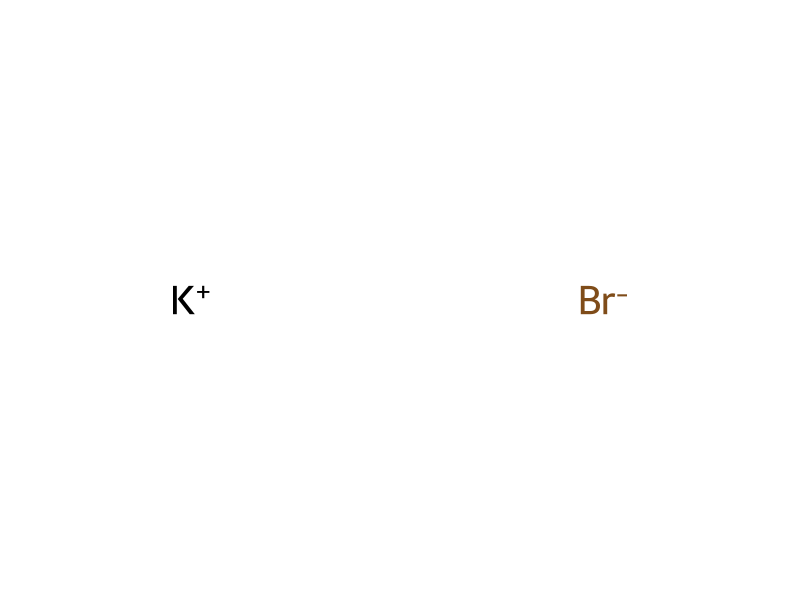
Potassium Bromide → HCID 12044122, compound
Reaction equation

[NH2:1][C:2]1[C:11]([CH3:12])=[C:10]([Cl:13])[CH:9]=[CH:8][C:3]=1[C:4]([O:6]C)=O.[Cl:14][C:15]1[CH:20]=[CH:19][C:18]([C:21]2[CH2:22][CH2:23][N:24]([CH2:27][CH2:28][CH2:29][NH2:30])[CH2:25][CH:26]=2)=[CH:17][CH:16]=1.CC1C=CC=C2C=1N[C:39](=[O:42])NC2=O.[K+].[Br-]>>[Cl:13][C:10]1[C:11]([CH3:12])=[C:2]2[C:3]([C:4](=[O:6])[N:30]([CH2:29][CH2:28][CH2:27][N:24]3[CH2:23][CH:22]=[C:21]([C:18]4[CH:19]=[CH:20][C:15]([Cl:14])=[CH:16][CH:17]=4)[CH2:26][CH2:25]3)[C:39](=[O:42])[NH:1]2)=[CH:8][CH:9]=1Participants


Procedure
The same general procedure was followed as in Example 7 with starting materials, 2-amino-3-methyl-4-chloro-benzoic acid, methyl ester and 3-[4-(4-Chloro-phenyl)-3,6-dihyro-2H-pyridin-1-yl]-propylamine to yield 7-Chloro-3-{3-[4-(4-chloro-phenyl)-3,6-dihydro-2H-pyridin-1-yl]-propyl{-8-methyl-1H-quinazoline-2,4-dione. The maleate salt of the compound has the following was found to have: Mp. 208-210° C.; 1H NMR DMSO-d6 δ 10.90 (s, 1H), 9.44 (brd s, 1H), 7.80 (d, J=8.7 Hz, 1H), 7.46 (dd, J=8.7, 20.5 Hz, 4H) 7.28 (d, J=8.5 Hz, 1H), 6.20 (brd s, 1H), 6.00 (s, 2H), 3.98 (t, J=6.4 Hz, 2H), 3.84-3.54 (m, 2H), 3.38-3.26 (m, 2H), 3.25-3.10 (m, 2H), 2.75-2.624(m, 2H), 2.39 (s, 3H), 2.10-1.99 (m, 2H); IR (KBr) 3351, 3226, 3071 2965, 2728, 2603, 1904, 1714, 1656, 1612, 1596, 1448, 1353, 1321, 1294, 1261, 1205, 1152, 1134, 1094, 1011, 989, 950, 922, 866, 836, 811, 763, 729, 706, 682, 645, 579, 523, 511, 499, 468, 441, 404; Analysis calculated for C23H23Cl2N3O2.C4H4O4: C, 57.86; H, 4.86; N, 7.50. Found: C, 57.55; H, 4.79; N, 67.36.
Workup
- customto yield 7-Chloro-3-{3-[4-(4-chloro-phenyl)-3,6-dihydro-2H-pyridin-1-yl]-propyl
Sources & evidence
- ORD record
- ord-3898672e0ac74f719ffe7385d790e249
- Source dataset
- uspto-grants-2003_02
- Patent number
- US06521630B1
Reaction notes
Loading…