Chloroacetonitrile → 5-tert-Butyl-2-(chloromethyl)-1,3-oxazole
Reaction equation

B(F)(F)F.CCOCC.[N+:10](=[CH:12][C:13](=[O:18])[C:14]([CH3:17])([CH3:16])[CH3:15])=[N-].C(=O)(O)[O-].[Na+].[Cl:24][CH2:25][C:26]#N>>[Cl:24][CH2:25][C:26]1[O:18][C:13]([C:14]([CH3:17])([CH3:16])[CH3:15])=[CH:12][N:10]=1Participants
5
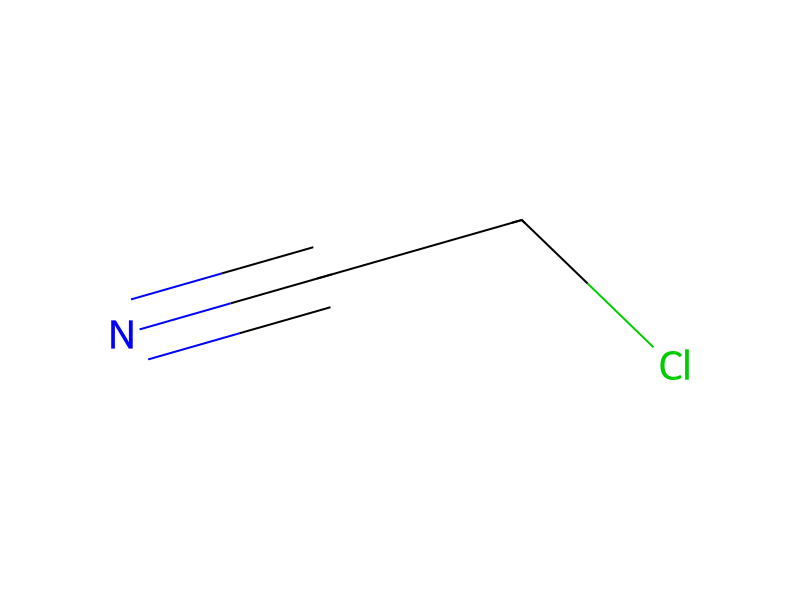




Conditions
- Temperature
- 0 °C
Procedure
To a solution of 2 mL (2.3 g, 16 mmol) of boron trifluoride etherate in 20 mL of chloroacetonitrile at 0° C. was added a solution of 1.33 g (10 mmol) of 1-diazo-3,3-dimethyl-2-butanone in 5 mL of chloroacetonitrile dropwise. The resulting solution was stirred at 0° C. for 0.5 h. The reaction mixture was added to saturated aqueous sodium bicarbonate solution to neutralize the acid and the product was extracted three times with dichloromethane. The combined extracts was dried (sodium sulfate), concentrated and purified by flash column chromatography (Merck silica, 25×200 mm, dichloromethane) to give 1.1 g of 2-(chloromethyl)-5-t-butyloxazole as a yellow liquid (6.4 mmol, 64% overall from the acid chloride).
Workup
- extractionthe product was extracted three times with dichloromethane
- dry with materialThe combined extracts was dried (sodium sulfate)
- concentrationconcentrated
- custompurified by flash column chromatography (Merck silica, 25×200 mm, dichloromethane)
Sources & evidence
- ORD record
- ord-bfb6d5cf150d40dca186ab0913abc78f
- Source dataset
- uspto-grants-2003_02
- Patent number
- US06521759B2
Reaction notes
Loading…