Hydrochloric Acid → 1-Methyl-1,2,3,4-tetrahydroisoquinoline
Reaction equation
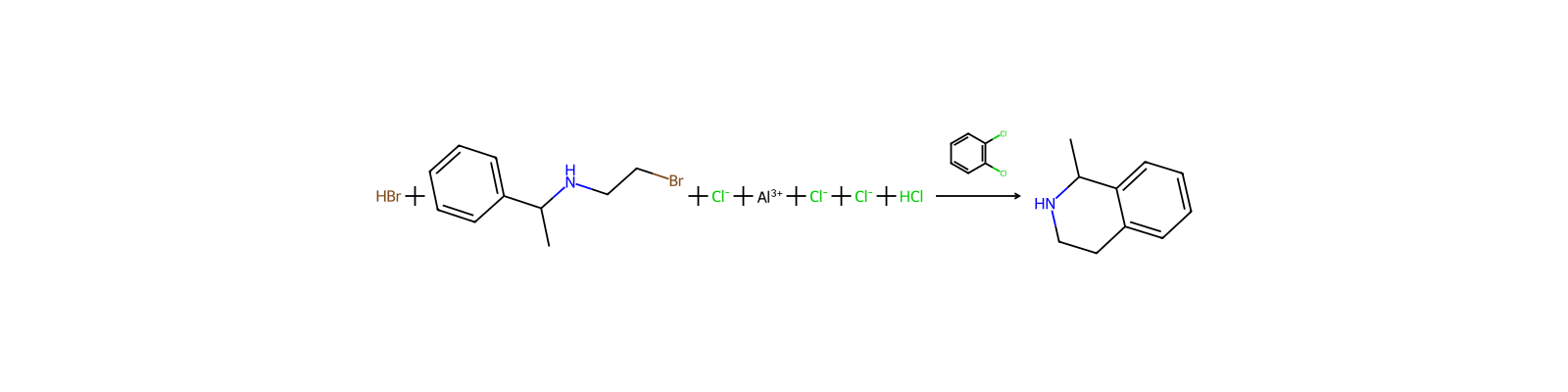
Br.Br[CH2:3][CH2:4][NH:5][CH:6]([CH3:13])[C:7]1[CH:12]=[CH:11][CH:10]=[CH:9][CH:8]=1.[Cl-].[Al+3].[Cl-].[Cl-].Cl>ClC1C=CC=CC=1Cl>[CH3:13][CH:6]1[C:7]2[C:12](=[CH:11][CH:10]=[CH:9][CH:8]=2)[CH2:3][CH2:4][NH:5]1Participants




Conditions
- Temperature
- 145 °C
Procedure
10.0 g (30.1 mmole) of N-(2-bromoethyl)-α-methylbenzylamine hydrobromide produced in Example 6(1) above was suspended in 60 ml of 1,2-dichlorobenzene and then heated to 145° C. 13.47 g (96.54 mmole) of anhydrous aluminum chloride was added thereto over 40 minutes. The reaction solution was stirred for a further 30 minutes at constant temperature, cooled to room temperature and poured onto 250 g of ice-water with stirring. 30 ml of con. hydrochloric acid was added thereto and the mixture was stirred for 10 minutes. This solution was washed three times, each time with 130 ml of dichloromethane, and the resulting aqueous layer was separated, adjusted to pH 12 with sodium hydroxide and then extracted three times, each time with 250 ml of ethyl acetate. The extracts were combined, washed with 40 ml of saturated saline, dehydrated with anhydrous magnesium sulfate and then evaporated under reduced pressure to remove ethyl acetate. The residue was distilled to obtain 2.90 g of the title compound.
Workup
- temperaturecooled to room temperature
- stirringwith stirring
- stirringthe mixture was stirred for 10 minutes
- washThis solution was washed three times
- customeach time with 130 ml of dichloromethane, and the resulting aqueous layer was separated
- extractionextracted three times
- washwashed with 40 ml of saturated saline
- customevaporated under reduced pressure
- customto remove ethyl acetate
- distillationThe residue was distilled
Sources & evidence
- ORD record
- ord-3d032245ee3f4e5592e685f2e6980e94
- Source dataset
- uspto-grants-2001_06
- Patent number
- US06252076B1
Reaction notes
Loading…