Acetone → phenyl N-methoxy-N-(2-methylphenyl)carbamate
Reaction equation
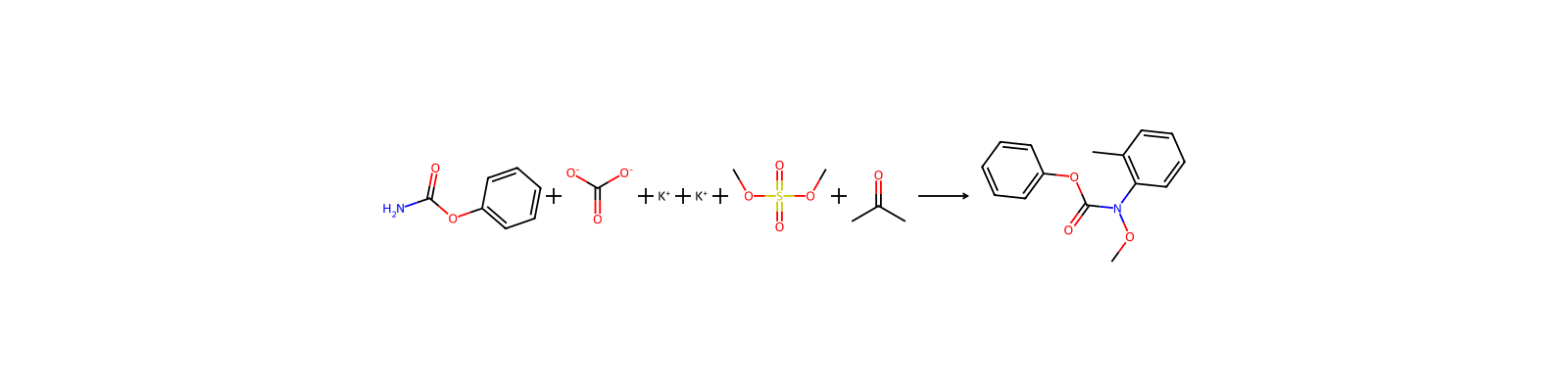
[C:1](=[O:10])([O:3][C:4]1[CH:9]=[CH:8][CH:7]=[CH:6][CH:5]=1)[NH2:2].[C:11]([O-:14])([O-])=O.[K+].[K+].S(OC)(OC)(=O)=O.[CH3:24][C:25]([CH3:27])=O>>[CH3:11][O:14][N:2]([C:24]1[CH:6]=[CH:5][CH:4]=[CH:9][C:25]=1[CH3:27])[C:1](=[O:10])[O:3][C:4]1[CH:9]=[CH:8][CH:7]=[CH:6][CH:5]=1Participants
5





Procedure
A mixture of 2.0 g (8.2 mmol) of the phenyl carbamate from Example 4a, 2 g (15 mmol) of K2CO3 and 1.3 g (10 mmol) of dimethyl sulfate in 20 ml of acetone is stirred for 3 hours at room temperature. The reaction mixture is then filtered and evaporated down, and the residue is purified by column chromatography with mixtures of cyclohexane and ethyl acetate. There is obtained 1.5 g (5.8 mmol{circumflex over (=)}71%) of the title compound as a colorless oil, which slowly crystallizes (mp=60° C.).
Workup
- filtrationThe reaction mixture is then filtered
- customevaporated down
- customthe residue is purified by column chromatography with mixtures of cyclohexane and ethyl acetate
Sources & evidence
- ORD record
- ord-7b40a3e3aa1244549afdb1ab6ee2dcae
- Source dataset
- uspto-grants-2001_06
- Patent number
- US06252083B1
Reaction notes
Loading…