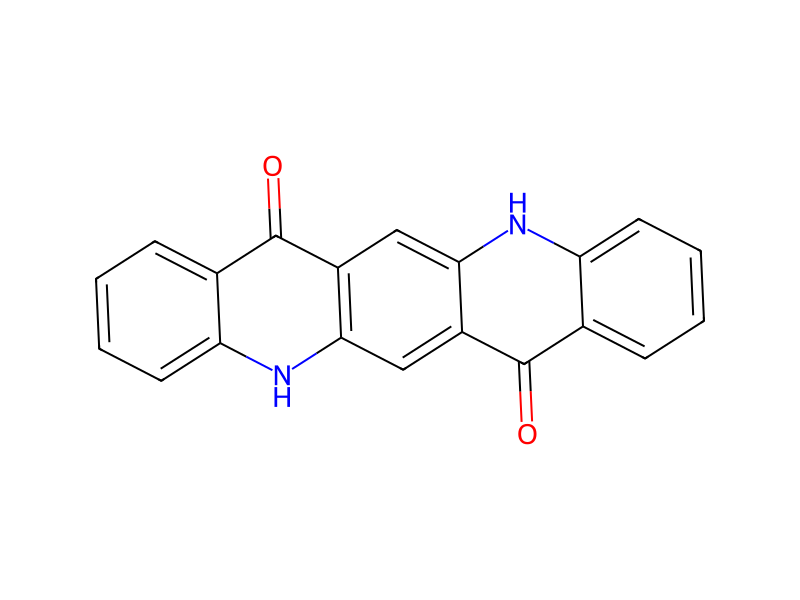
HCID 131724965, compound → Quinacridone
Reaction equation

[CH:1]1[C:6](Cl)=[CH:5][C:4]2[C:8]([C:10]3[C:15]([NH:16][C:3]=2[CH:2]=1)=[CH:14][C:13]1[C:17]([C:19]2[CH:25]=[C:24](Cl)[CH:23]=[CH:22][C:20]=2[NH:21][C:12]=1[CH:11]=3)=[O:18])=[O:9].C=O.C1(S(O)(=O)=O)C2C(=CC=CC=2)C=CC=1.C1C=C2C(C3C(NC2=CC=1)=CC1C(C2C(NC=1C=3)=CC=CC=2)=O)=O.C=O.C1(S(O)(=O)=O)C2C(=CC=CC=2)C=CC=1>>[CH:24]1[CH:25]=[C:19]2[C:17]([C:13]3[C:12]([NH:21][C:20]2=[CH:22][CH:23]=1)=[CH:11][C:10]1[C:8]([C:4]2[C:3]([NH:16][C:15]=1[CH:14]=3)=[CH:2][CH:1]=[CH:6][CH:5]=2)=[O:9])=[O:18]Participants
3


Procedure
The procedure of Example 8 is repeated, but using 4 g of the aqueous presscake of the nanosize 2,9-dichloro quinacridone/naphthalene sulfonic acid formaldehyde polymer mixture according to Example 4 instead of 7 g of the aqueous presscake of the nanosize quinacridone/naphthalene sulfonic acid formaldehyde polymer mixture presscake according to Example 1. A violet beta quinacridone pigment of similar good pigment properties is obtained.
Sources & evidence
- ORD record
- ord-abbf253c1a52475c8bdabeab75ddea6f
- Source dataset
- uspto-grants-2005_06
- Patent number
- US06902613B2
Reaction notes
Loading…