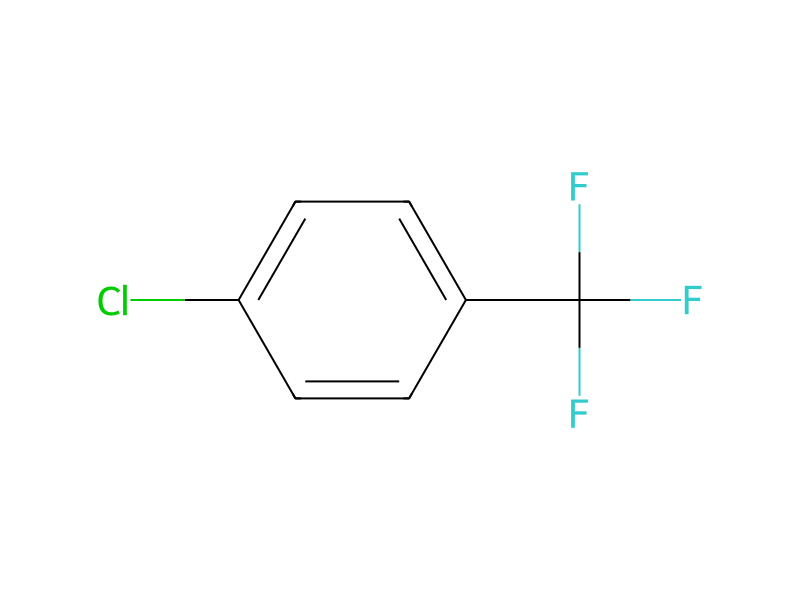
Azobisisobutyronitrile → 1-Chloro-4-(trifluoromethyl)benzene
Reaction equation

BrBr.N(C(C)(C)C#N)=NC(C)(C)C#N.[Cl:15][C:16]1[CH2:21][CH2:20][CH:19]([C:22]([F:25])([F:24])[F:23])[CH2:18][CH:17]=1>>[Cl:15][C:16]1[CH:17]=[CH:18][C:19]([C:22]([F:23])([F:24])[F:25])=[CH:20][CH:21]=1Participants
4



Procedure
The solution is heated to 60°-70° C. with stirring, using a magnetic stirring bar. Bromine, 32 g (0.2 mole), is added dropwise sub-surface. The reddish color dissipates quickly and a gas evolution occurs. A catalytic amount of radical initiator such as azodiisobutyronitrile may be added intermittently to promote the reaction. When the color begins to sustain, the pot temperature is raised to 90°-100° C. The remaining bromine is added in the same fashion. The pot temperature can be raised to 110°-120° C. for 2-4 hours. During this period, an additional amount of bromine such as 1-2 g may be added to complete the conversion of (I). 4-chlorobenzotrifluoride can be obtained in a good yield by fractional distillation of the mixture.
Workup
- temperatureThe solution is heated to 60°-70° C.
- customthe reaction
- temperaturethe pot temperature is raised to 90°-100° C
- temperatureThe pot temperature can be raised to 110°-120° C. for 2-4 hours
- waitDuring this period
Sources & evidence
- ORD record
- ord-d9fd0b0d4bbb44e9a046b533972aead8
- Source dataset
- uspto-grants-1990_11
- Patent number
- US04968830
Reaction notes
Loading…