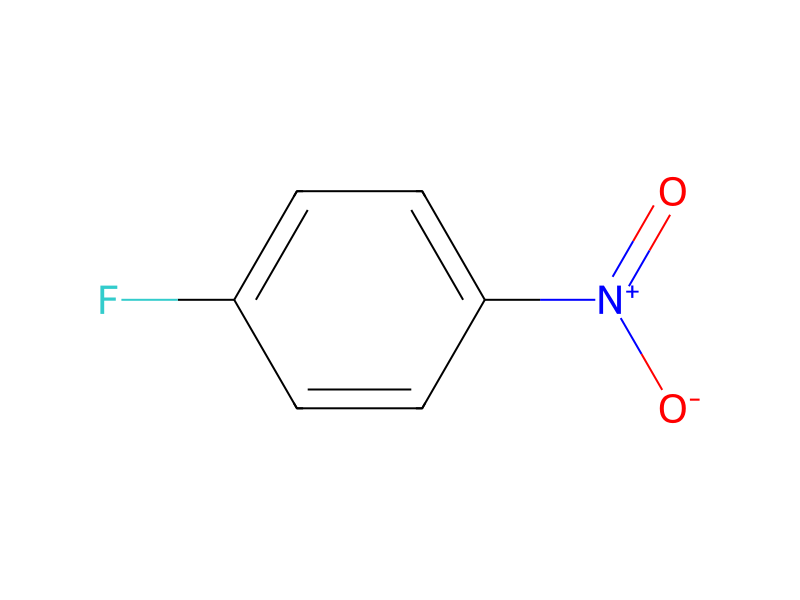
1-Chloro-4-nitrobenzene → p-Fluoronitrobenzene
Reaction equation

Cl[C:2]1[CH:7]=[CH:6][C:5]([N+:8]([O-:10])=[O:9])=[CH:4][CH:3]=1.[F-:11].[K+]>S1(CCCC1)(=O)=O.[Cl-].C([N+]1C=CC(N(CCCC)CCCC)=CC=1)C(C)(C)C>[F:11][C:2]1[CH:7]=[CH:6][C:5]([N+:8]([O-:10])=[O:9])=[CH:4][CH:3]=1Participants
5
Reactant 2


Product 1
Reagents, catalysts & solvents 2


Procedure
A reaction mixture of 85.3 g of 4-chloronitrobenzene (CNB), 45.3 g of potassium fluoride, 1.4 g of the N-neopentyl-4-(N',-N'-di-n-butylamino)pyridinium chloride (NPDBAPC) obtained in Example lII in 109.6 g of sulfolane was heated with stirring for 9 hours at 205°-215° C. At the end of this period, HPLC assay of a sample of the reaction mixture indicated less than 1% residual CNB. Simple distillation of the reaction mixture under vacuum gave 73.6 g of 4-fluoronitrobenzene (FNB) for a 96.3% yield.
Workup
- temperaturewas heated
- distillationSimple distillation of the reaction mixture under vacuum
Sources & evidence
- ORD record
- ord-aeaf7bb70e374d6e8e8a31961025304d
- Source dataset
- uspto-grants-1990_11
- Patent number
- US04973772
Reaction notes
Loading…