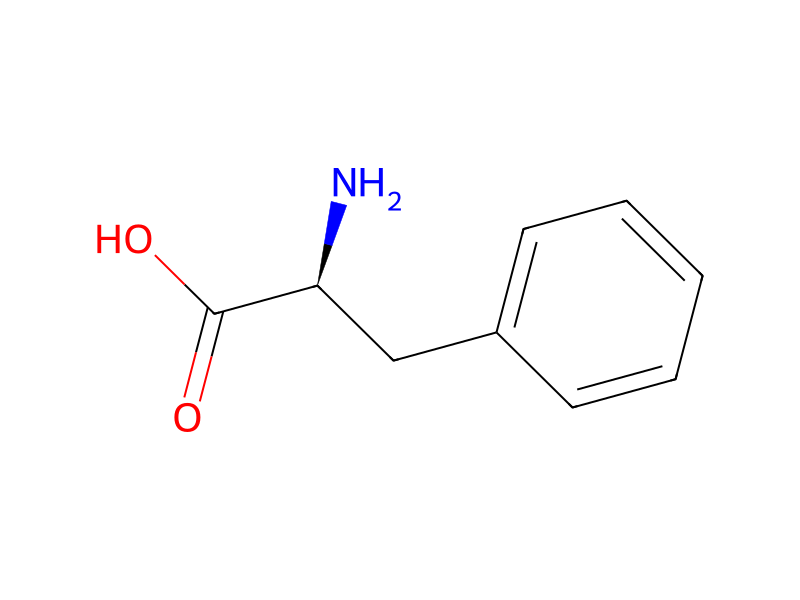
L-Phenylalanine → 1,2,3,4-Tetrahydroquinoline-3-carboxylic acid
Reaction equation

O[C:2]1[CH:3]=[C:4]2[C:9](=[CH:10][CH:11]=1)[NH:8][CH2:7][CH:6]([C:12]([OH:14])=[O:13])[CH2:5]2.C1C=CC(C(O)C(N)C(O)=O)=CC=1.N[C@H](C(O)=O)CC1C=CC=CC=1>>[NH:8]1[C:9]2[C:4](=[CH:3][CH:2]=[CH:11][CH:10]=2)[CH2:5][CH:6]([C:12]([OH:14])=[O:13])[CH2:7]1Participants
4


Procedure
That same document describes the preparation of (-)-6-hydroxy-1,2,3,4-tetrahydroquinoline-3-carboxylic acid with an optical purity of 100% and a yield of 95%, from m-tyrosine in accordance with the same method. However, where L-phenylalanine is used as the starting material, it is not possible to obtain a (-)-1,2,3,4-tetrahydroquinoline-3-carboxylic acid with 100% optical purity.
Sources & evidence
- ORD record
- ord-0b0c5b38ea9c41d884998c2e3be501f1
- Source dataset
- uspto-grants-1999_05
- Patent number
- US05905155
Reaction notes
Loading…