HuagongsheHuagongshe Chemistry Print Report · For research reference only
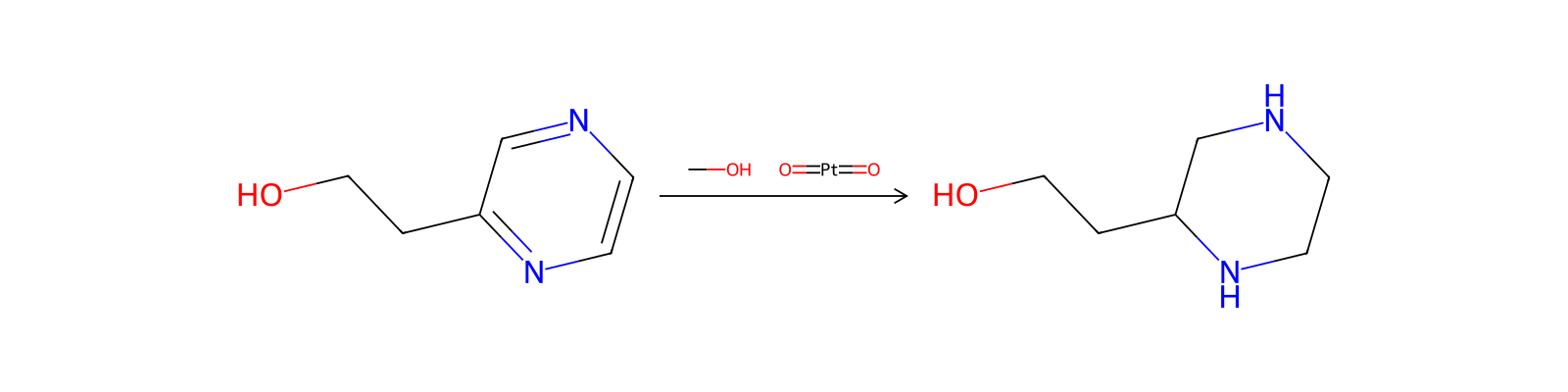
2-(pyrazin-2-yl)ethanol → Piperazineethanol
Participants
| Role | Name | HCID | Charge |
|---|---|---|---|
| Reactant | 2-(pyrazin-2-yl)ethanol | HCID 522247 | — |
| Catalyst | Adams' catalyst | HCID 345198 | — |
| Solvent | Methanol | HCID 887 | — |
| Product | Piperazineethanol | HCID 91308 | — |
Reaction Steps
A method for preparing each of the foregoing compounds is presented in the following examples. In general, however, the preparation is one wherein 2-(2-hydroxyethyl)-pyrazine (L. J. Kitchen and E. S. Hanson, Antibiot. Chemo., 73, 1838 (1951)) was reduced with H2 and PtO2 in MeOH to yield 2-(2-hydroxyethyl)piperazine (E. F. Rogers and H. J. Becker, U.S. Pat. No. 3,281,423 (1966)) which, in turn, was converted to the chloride. Ring closure in base afforded 1,4-diazabicyclo[ 3.2.1]octane which was acylated with ethylchloroformate to give 4-carbethoxy-1,4-diazabicyclo[ 3.2.1] octane or with diethylcarbamyl chloride to give 4-diethylcarbamyl-1,4-diazabicyclo[ 3.2.1] octane.
Provenance & Evidence
| DOI | 10.6084/m9.figshare.5104873.v1 |
|---|---|
| Patent number | US03954766 |
| Source dataset | uspto-grants-1976_05 |
| ORD ID | ord-43e8a488a05449f293c4dedba1cb9c98 |
| Source note | uspto-grants-1976_05 |