2-(pyrazin-2-yl)ethanol → Piperazineethanol
Reaction equation
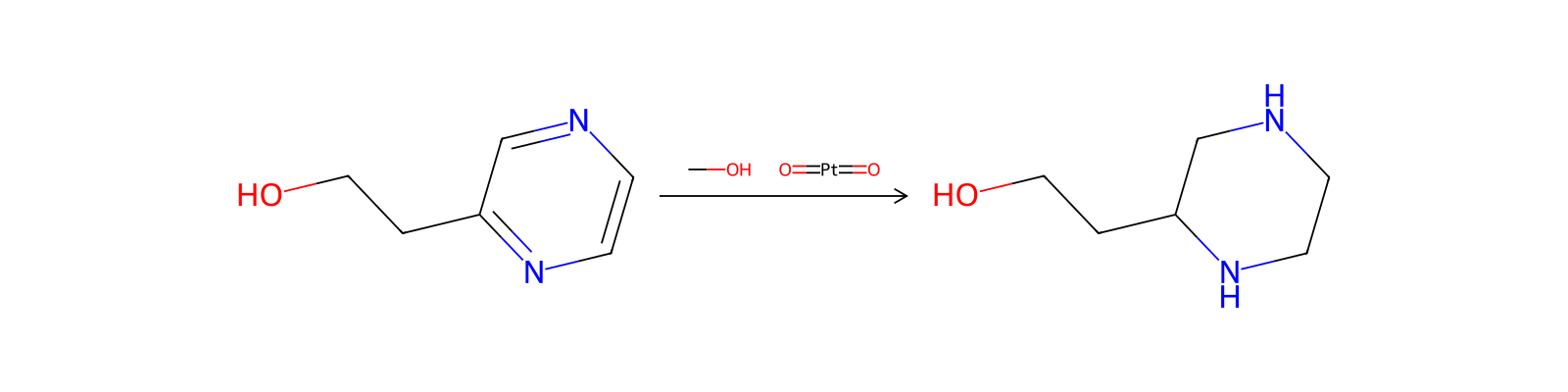
[OH:1][CH2:2][CH2:3][C:4]1[CH:9]=[N:8][CH:7]=[CH:6][N:5]=1>CO.O=[Pt]=O>[OH:1][CH2:2][CH2:3][CH:4]1[CH2:9][NH:8][CH2:7][CH2:6][NH:5]1Participants
4
Reactant 1

Product 1

Reagents, catalysts & solvents 2


Procedure
A method for preparing each of the foregoing compounds is presented in the following examples. In general, however, the preparation is one wherein 2-(2-hydroxyethyl)-pyrazine (L. J. Kitchen and E. S. Hanson, Antibiot. Chemo., 73, 1838 (1951)) was reduced with H2 and PtO2 in MeOH to yield 2-(2-hydroxyethyl)piperazine (E. F. Rogers and H. J. Becker, U.S. Pat. No. 3,281,423 (1966)) which, in turn, was converted to the chloride. Ring closure in base afforded 1,4-diazabicyclo[ 3.2.1]octane which was acylated with ethylchloroformate to give 4-carbethoxy-1,4-diazabicyclo[ 3.2.1] octane or with diethylcarbamyl chloride to give 4-diethylcarbamyl-1,4-diazabicyclo[ 3.2.1] octane.
Workup
- customA method for preparing each of the foregoing compounds
Sources & evidence
- ORD record
- ord-43e8a488a05449f293c4dedba1cb9c98
- Source dataset
- uspto-grants-1976_05
- Patent number
- US03954766
Reaction notes
Loading…