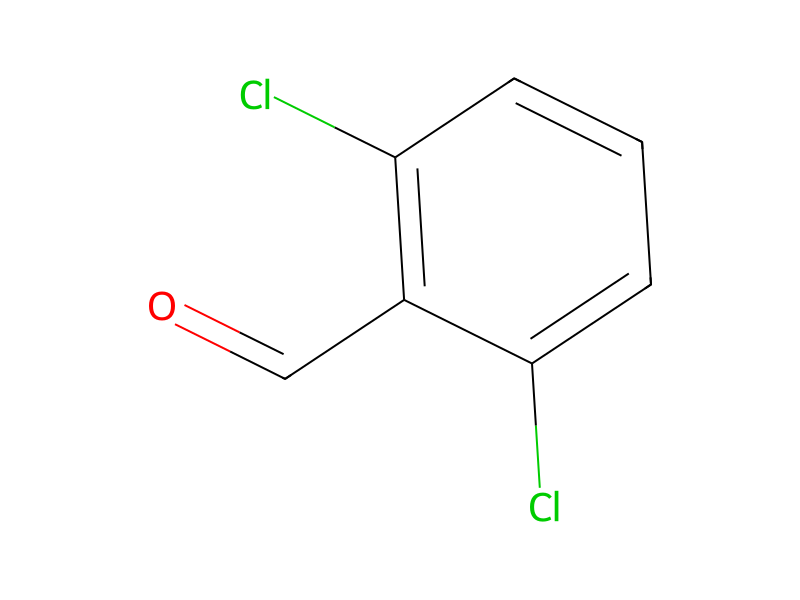
2,6-Dichlorobenzaldehyde → 4-Methoxy-2-(2', 6'-Dichlorophenyl)indan-1,3-dione
Reaction equation

[Cl:1][C:2]1[CH:9]=[CH:8][CH:7]=[C:6]([Cl:10])[C:3]=1[CH:4]=O.[CH3:11][O:12][C:13]1[CH:22]=[CH:21][CH:20]=[C:19]2[C:14]=1[CH2:15][O:16][C:17]2=[O:18].C[O-].[Na+]>C(OCC)(=O)C.CO>[CH3:11][O:12][C:13]1[CH:22]=[CH:21][CH:20]=[C:19]2[C:14]=1[C:15](=[O:16])[CH:4]([C:3]1[C:2]([Cl:1])=[CH:9][CH:8]=[CH:7][C:6]=1[Cl:10])[C:17]2=[O:18]Participants





Procedure
A solution of 2,6-dichlorobenzaldehyde (5.98 grams, 0.034 mole) and 4-methoxyphthalide (5.6 grams, 0.34 mole) in 20.5 milliliters of ethyl acetate was added to a solution of sodium methoxide in methanol (prepared from 2.36 grams of sodium metal and 34 milliliters of methanol). The mixture was then heated under reflux for 1 hour. The bulk of the ethyl acetate and methanol was removed under reduced pressure. The residue was dissolved in water and the solution filtered from insoluble material. Acidification of the filtered alkaline solution afforded 9.0 grams of a yellow solid which was recrystallized from ethanol to give 6.5 grams (59.3%) of the title compound, melting point 163°-165°C. Calc'd: C, 59.83, H, 3.14; Found: C, 59.55, H, 3.19.
Workup
- temperatureThe mixture was then heated
- temperatureunder reflux for 1 hour
- customThe bulk of the ethyl acetate and methanol was removed under reduced pressure
- dissolutionThe residue was dissolved in water
- filtrationthe solution filtered from insoluble material
Sources & evidence
- ORD record
- ord-e8ad99ef34d748a8a849ec2d7f01031e
- Source dataset
- uspto-grants-1976_05
- Patent number
- US03954998
Reaction notes
Loading…