1-(4-Chlorophenyl)ethylamine → HCID 86749736, compound
Reaction equation

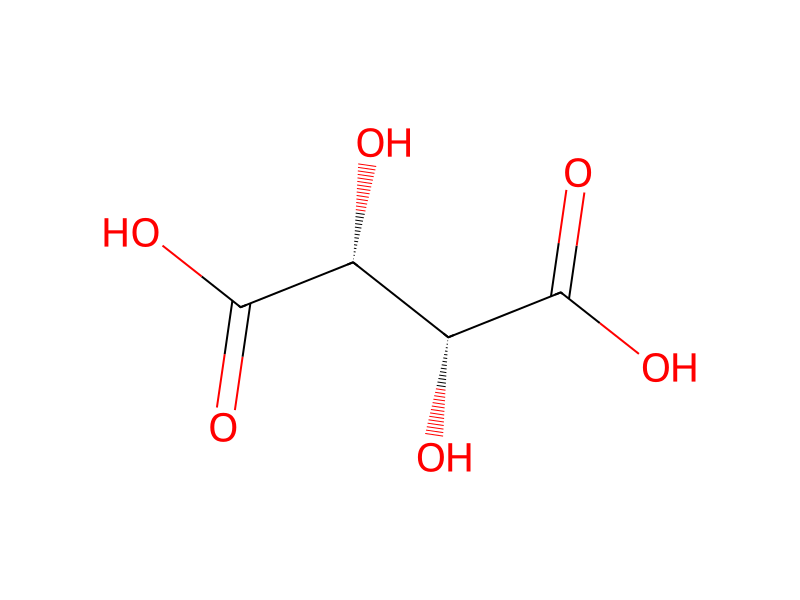
[Cl:1][C:2]1[CH:7]=[CH:6][C:5]([CH:8]([NH2:10])[CH3:9])=[CH:4][CH:3]=1.[C:11]([OH:20])(=[O:19])[C@@H:12]([C@H:14]([C:16]([OH:18])=[O:17])[OH:15])[OH:13]>>[C:16]([CH:14]([CH:12]([C:11]([OH:20])=[O:19])[OH:13])[OH:15])([OH:18])=[O:17].[Cl:1][C:2]1[CH:7]=[CH:6][C:5]([CH:8]([NH2:10])[CH3:9])=[CH:4][CH:3]=1Participants
3


Procedure
The (-)-enantiomer (starting material for Example 57) was prepared in conventional manner as follows. A warm solution of (±)1-(4-chlorophenyl)ethylamine (101 g) and L(+)tartaric acid (97.3 g) in IMS (7 l) was allowed to cool slowly and to stand at ambient temperature for 3 days. The solid formed was collected by filtration, washed with IMS and recrystallised twice from IMS to give (-)1-(4-chlorophenyl)ethylamine (+) tartrate, m.p. 195°-196° C. The salt was suspended in water and basified with aqueous ammonia (specific gravity 0.88). The mixture was extracted with diethyl ether to give (-) 1-(4-chlorophenyl)ethylamine (free base) which was distilled at 122°-124° C. (28 mmHg). Chiral HPLC indicated enantiomeric purity of 96.8%.
Workup
- customThe (-)-enantiomer (starting material for Example 57) was prepared in conventional manner
- temperatureto cool slowly
- customThe solid formed
- filtrationwas collected by filtration
- washwashed with IMS
- customrecrystallised twice from IMS
Sources & evidence
- ORD record
- ord-18723eb16cb84f57b1eb1a596a9f739e
- Source dataset
- uspto-grants-1996_08
- Patent number
- US05547972
Reaction notes
Loading…