Water → HCID 565761, compound
Reaction equation

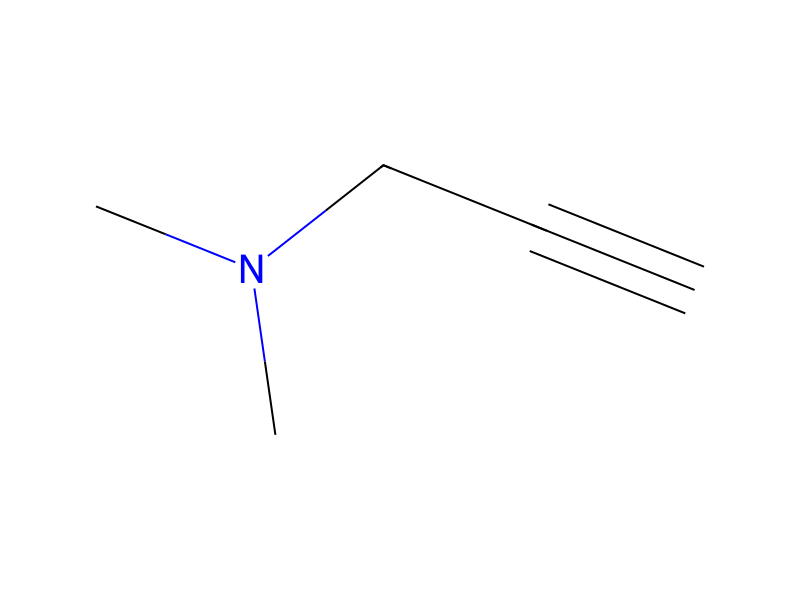
[O:1]1[CH:5]=[CH:4][CH:3]=[C:2]1[C:6](Cl)=[O:7].C([N:11]([CH2:14][CH3:15])CC)C.CN(C)[CH2:18][C:19]#C.O.[CH2:23](Cl)Cl>>[CH3:23][C:14]([NH:11][C:6]([C:2]1[O:1][CH:5]=[CH:4][CH:3]=1)=[O:7])([CH3:15])[C:18]#[CH:19]Participants





Procedure
2-Furoyl chloride (6.5 gm, 0.05 m) was dissolved in methylene chloride (200 ml), cooled to 0° to -5° C. and maintained under a nitrogen atmosphere. Triethylamine (10 ml) and then dimethylpropargylamine (4.2 gm, 0.051 m) were gradually added with stirring while maintaining the temperature at 0°±5° C. for about one-half hour and then at room temperature for about 1 hour. Water (100 ml) was added and the reaction slurry was transferred, using methylene chloride (100 ml) as a rinse, to a separatory funnel. The aqueous layer was sequentially separated and the methylene chloride layer was washed with water (50 ml), 5% hydrochloric acid (1×100 ml), saturated sodium bicarbonate (1×50 ml), water (1×50 ml) and then brine. The solvent was evaporated after drying over magnesium sulfate and 8.0 gms of product were obtained. The starting materials for all compounds except 7, 8 and 11 can be prepared in an analogous manner.
Workup
- temperaturecooled to 0° to -5° C.
- temperaturemaintained under a nitrogen atmosphere
- temperaturewhile maintaining the temperature at 0°±5° C. for about one-half hour
- customThe aqueous layer was sequentially separated
- washthe methylene chloride layer was washed with water (50 ml), 5% hydrochloric acid (1×100 ml), saturated sodium bicarbonate (1×50 ml), water (1×50 ml)
- customThe solvent was evaporated
- dry with materialafter drying over magnesium sulfate
Sources & evidence
- ORD record
- ord-14c66a6539894f44aa5ca0722e046d67
- Source dataset
- uspto-grants-1996_08
- Patent number
- US05547984
Reaction notes
Loading…