Water → beta-Maltose
Reaction equation

[O:1]=[CH:2][C@@H:3]([C@H:5]([C@@H:7]([C@@H:9]([CH2:11][OH:12])[OH:10])[OH:8])[OH:6])[OH:4].[OH2:13]>>[CH2:11]([OH:12])[C@H:9]1[O:10][C@H:2]([O:1][C@H:7]2[C@H:5]([OH:6])[C@@H:3]([OH:4])[C@H:2]([OH:1])[O:13][C@@H:9]2[CH2:11][OH:12])[C@H:3]([OH:4])[C@@H:5]([OH:6])[C@@H:7]1[OH:8]Participants


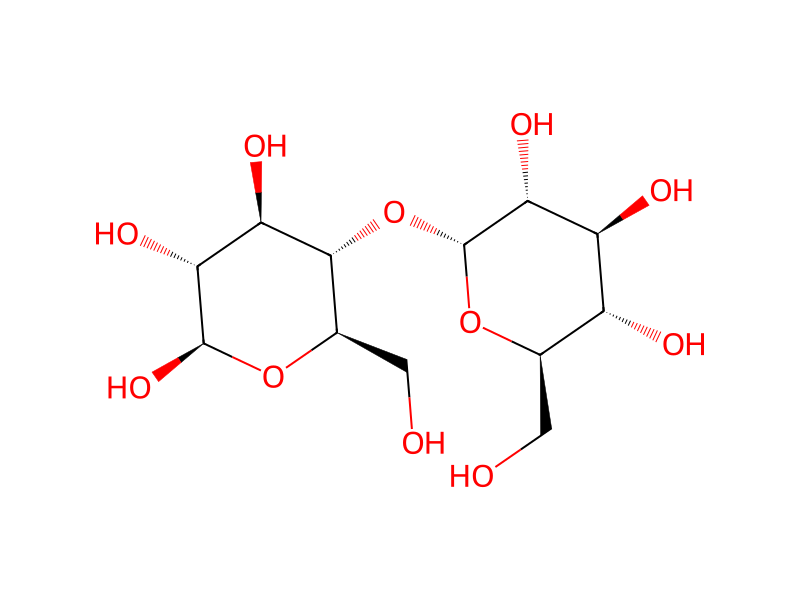
Conditions
- Temperature
- 130 °C
Procedure
A suspension containing 2 parts by weight of corn starch and 7 parts by weight of water was added with a commercially-available liquefying α-amylase derived from a microorganism, and heated to 90°-100° C. to effect gelatinization and liquefaction. Thereafter, the mixture was heated at 130° C. to cease the enzymatic reaction, followed by recoverying a liquefied solution with a dextrose equivalent (DE) of about 2. The resultant solution was first cooled to 55° C., then added with 150 units per g starch of isoamylase (EC 3.2.1.68) derived from a microorganism of the species Pseudomonas amyloderamosa commercialized by Hayashibara Biochemical Laboratories Inc., Okayama, Japan, and 40 units per g dextrin of β-amylase (EC 3.2.1.2) commercialized by Nagase Biochemicals Ltd., Kyoto, Japan. The resultant mixture was kept at pH 5.0 and subjected to an enzymatic reaction for 24 hours to obtain a maltose-rich saccharide solution which was then heated to inactivate the remaining enzyme. Thus, a maltose-rich saccharide solution was obtained.
Workup
- additionwas added with a commercially-available liquefying
- temperatureheated to 90°-100° C.
- customthe enzymatic reaction
- additionadded with 150 units
- customsubjected to an enzymatic reaction for 24 hours
Sources & evidence
- ORD record
- ord-2a734157281648878cfd0c68a346b48c
- Source dataset
- uspto-grants-1996_08
- Patent number
- US05550226
Reaction notes
Loading…