N-bromobutanimide → 4-Chloro-5-fluoro-alpha-bromo-2-picoline
Reaction equation

[Cl:1][C:2]1[C:7]([F:8])=[CH:6][N:5]=[C:4]([CH3:9])[CH:3]=1.[Br:10]N1C(=O)CCC1=O>ClCCCl.C(Cl)Cl>[Cl:1][C:2]1[C:7]([F:8])=[CH:6][NH:5][C:4]([Br:10])([CH3:9])[CH:3]=1Participants
Reactant 2

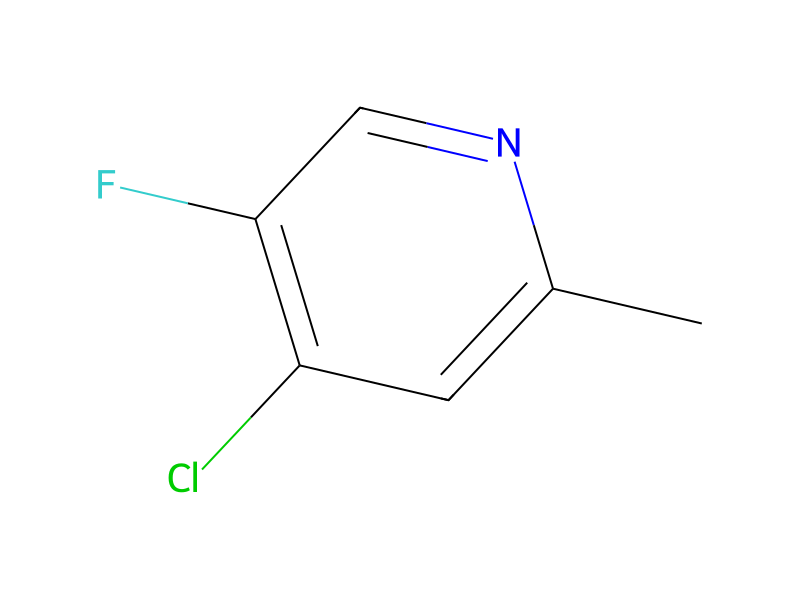
Product 1

Reagents, catalysts & solvents 2


Conditions
- Temperature
- 75 °C
Procedure
4-Chloro-5-fluoro-2-picoline (2.9 g, 20 mmol), the product of Example 66, was dissolved in 50 mL of 1,2-dichloroethane in a dry flask. The resultant solution was heated, with stirring, to 75° C. and 4.09 (23 mmol) of N-bromosuccinimide was added, followed by 100 mG (0.7 mmol) of 2,2-azobisisobutyronitrile (AIBN), a free radical initiator. After the reaction mixture was stirred at 75° C. for 24 hours, it was diluted with 450 mL of methylene chloride and washed with 3×400 mL of water. The organic layer was separated and dried over anhydrous sodium sulfate, filtered and concentrated under reduced pressure. The residue was dried in vacuo to give 3.5 g (69% yield) of the title compound as an amber oil; 1H NMR (CDCl3) d 4.50 (s, 2H), 7.54 (d, 1H), 8.44 (s, 1H).
Workup
- stirringAfter the reaction mixture was stirred at 75° C. for 24 hours
- washwashed with 3×400 mL of water
- customThe organic layer was separated
- dry with materialdried over anhydrous sodium sulfate
- filtrationfiltered
- concentrationconcentrated under reduced pressure
- customThe residue was dried in vacuo
Sources & evidence
- ORD record
- ord-f274be8d731f425884197cae074e7e36
- Source dataset
- uspto-grants-1996_12
- Patent number
- US05580872
Reaction notes
Loading…