Acetic Anhydride → HCID 86750079, compound
Reaction equation

O=C[C@@H]([C@H]([C@@H]([C@@H](CO)O)O)O)O.C(N(C)NC(=O)C)(=O)C.C([N:25]([CH2:31][C@@H:32]([C@H:34]([C@@H:36]([C@@H:38]([CH2:40][OH:41])[OH:39])[OH:37])[OH:35])[OH:33])[N:26](C(=O)C)[CH3:27])(=O)C.[C:42]([O:45]C(=O)C)(=[O:44])[CH3:43]>CNN.N1C=CC=CC=1>[C:42]([OH:45])(=[O:44])[CH3:43].[C:42]([OH:45])(=[O:44])[CH3:43].[C:42]([OH:45])(=[O:44])[CH3:43].[C:42]([OH:45])(=[O:44])[CH3:43].[C:42]([OH:45])(=[O:44])[CH3:43].[C:42]([OH:45])(=[O:44])[CH3:43].[C:42]([OH:45])(=[O:44])[CH3:43].[CH3:27][NH:26][NH:25][CH2:31][C@@H:32]([C@H:34]([C@@H:36]([C@@H:38]([CH2:40][OH:41])[OH:39])[OH:37])[OH:35])[OH:33]Participants
Reactant 4




Product 1

Reagents, catalysts & solvents 2

Procedure
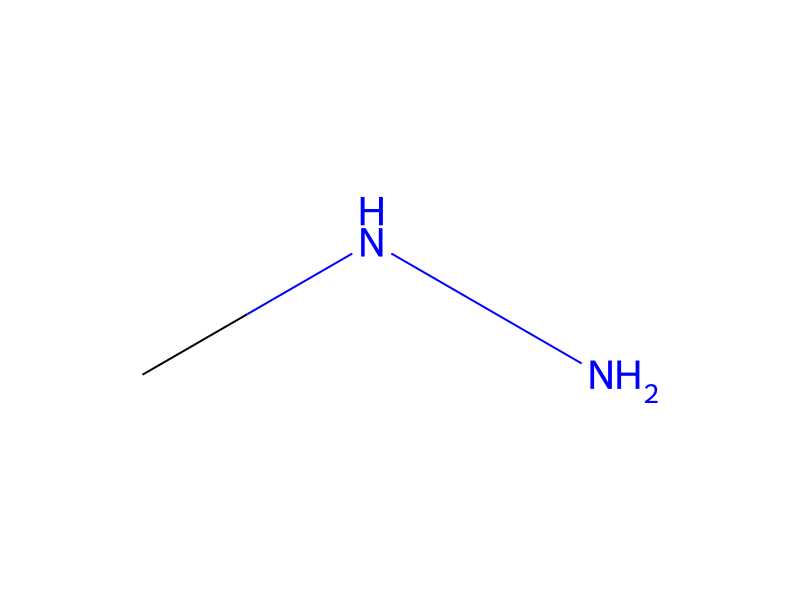
D-glucose (0.100 mmol) was dissolved in 1.0 mL methylhydrazine (Aldrich Chemical company) in a Pierce reacti-vial, and capped under nitrogen with a cap having a Pierce Tuf-bond teflon-silicone seal. The sample, after sitting at room temperature for 16 hours, was converted to the methylhydrazone derivative of D-glucose which was evaporated to a resin-like material in a Speed-Vac concentrator. The sample was quantitatively transferred in a 1.0 mL volume of water into a 20 mL test tube, and 100 mg of sodium borohydride was added, which reduced the molecule to 1-deoxy-1-(N'-methylhydrazino)-D-glucitol. After 24 hours, the sample was placed in an ice-water bath and 0.200 mL of glacial acetic acid was added, dropwise, over about a 30 second interval. The sample was diluted with 1.0 mL water. To it was added 200 mg of sodium bicarbonate and the bicarbonate was permitted to dissolve, with occasional mixing. Then, 0.100 mL acetic anhydride was added, followed by gentle swirling to dissolve all of it. After 10 minutes, another 0.100 mL acetic anhydride was added, the solution gently swirled to dissolve it, and, after an additional 50 minutes, the sample was diluted with 5.0 mL water and loaded on a column containing 10-12 mL of well-washed Dowex AG1-X8, 100-200 mesh, H+ form, to remove sodium. The column was washed with five additional washes of 10 mL water. The total eluate was rotary evaporated to near dryness, and then rotary evaporated to dryness five times with 20 mL of 1% acetic acid in methanol, and three times with 20 mL methanol alone, to remove boric acid, thereby resulting in 1-deoxy-1-(N,N'-diacetyl-N'-methylhydrazino)-D-glucitol. This sample contained some additional N,N'-diacetyl-N-methylhydrazine. It was either directly O-peracetylated as described below, or it was chromatographically purified prior to O-acetylation by high-performance liquid chromatography on a Waters GlycoPak N column (7.8×300 mm), using isocratic acetonitrile/water, at 85/15, vol/vol, at 1.0 mL/min, monitoring at a wavelength of 200 nm, giving a product eluting at 32 minutes. For per-O-acetylation, 1.0 μmol of 1-deoxy-1-(N,N'-diacetyl-N'-methylhydrazino)-D-glucitol (1.0 μmol) was dried in a Pierce reacti-vial in a Speed-Vac rotary concentrator. The dried sample was taken up in 100 μL of dry pyridine (Pierce, silylation grade) and 50 μL acetic anhydride was added. The sample was kept under argon for 24 hours at room temperature, whereupon the solvent was removed with a Speed-Vac rotary concentrator. The sample was solubilized in about 0.5 mL chloroform, and again concentrated on a Speed-Vac rotary concentrator. The sample was then taken up in 20 μL of chloroform for fast-atom bombardment (FAB) MS analysis. Analysis of the per-O-acetylated material showed a single sugar derivative, with mass ions (FABMS) at 505 (MH)+, 463 (MH-42)+ and 445 (MH-60)+ and upon addition of sodium ion, 527 (M+Na)+. These data show that the product is 1-deoxy-1-(N'-methylhydrazino)-D-glucitol heptaacetate.
Workup
- customcapped under nitrogen with a cap
- customseal
- customwas evaporated to a resin-like material in a Speed-Vac concentrator
- customThe sample was quantitatively transferred in a 1.0 mL volume of water into a 20 mL test tube
- addition100 mg of sodium borohydride was added
- waitAfter 24 hours
- customthe sample was placed in an ice-water bath
- addition0.200 mL of glacial acetic acid was added
- customover about a 30 second interval
- additionThe sample was diluted with 1.0 mL water
- additionTo it was added 200 mg of sodium bicarbonate
- dissolutionto dissolve, with occasional mixing
- additionThen, 0.100 mL acetic anhydride was added
- dissolutionto dissolve all of it
- waitAfter 10 minutes
- additionanother 0.100 mL acetic anhydride was added
- dissolutionto dissolve it
- waitafter an additional 50 minutes
- additionthe sample was diluted with 5.0 mL water
- additioncontaining 10-12 mL of well-washed Dowex AG1-X8, 100-200 mesh, H+ form
- customto remove sodium
- washThe column was washed with five additional washes of 10 mL water
- customThe total eluate was rotary evaporated
- customrotary evaporated to dryness five times with 20 mL of 1% acetic acid in methanol, and three times with 20 mL methanol alone
- customto remove boric acid
- customresulting in 1-deoxy-1-(N,N'-diacetyl-N'-methylhydrazino)-D-glucitol
- customwas chromatographically purified
- customat 85/15, vol/vol, at 1.0 mL/min, monitoring at a wavelength of 200 nm, giving a product
- washeluting at 32 minutes
- waitThe sample was kept under argon for 24 hours at room temperature, whereupon the solvent
- customwas removed with a Speed-Vac rotary concentrator
- concentrationagain concentrated on a Speed-Vac rotary concentrator
- additionwith mass ions (FABMS) at 505 (MH)+, 463 (MH-42)+ and 445 (MH-60)+ and upon addition of sodium ion, 527 (M+Na)+
Sources & evidence
- ORD record
- ord-1044188331fb4a2aacdbda8c2e8e20bd
- Source dataset
- uspto-grants-1996_12
- Patent number
- US05585473
Reaction notes
Loading…