Cyclohexene oxide → rel-(1R,2S)-2-Phenylcyclohexanol
Reaction equation

[C:1]1([Mg]Br)[CH:6]=[CH:5][CH:4]=[CH:3][CH:2]=1.[CH:9]12[O:15][CH:10]1[CH2:11][CH2:12][CH2:13][CH2:14]2>O1CCCC1>[C:1]1([C@@H:9]2[CH2:14][CH2:13][CH2:12][CH2:11][C@H:10]2[OH:15])[CH:6]=[CH:5][CH:4]=[CH:3][CH:2]=1Participants
Reactant 2


Product 1
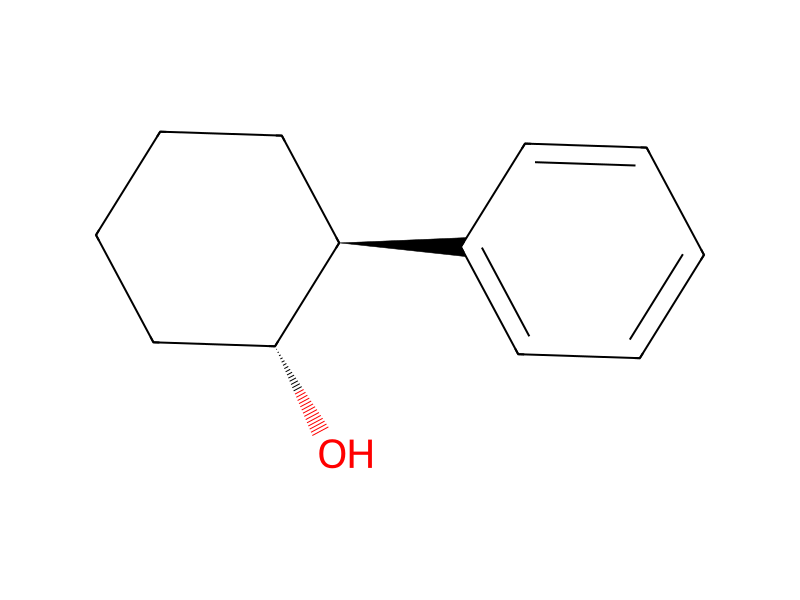
Reagents, catalysts & solvents 1

Conditions
- Temperature
- 15 °C
Procedure
A 50-L reactor equipped with a stirrer, a gas bubbler, and an addition funnel was placed under argon, charged with 27.36 L (27.63 mole) of phenylmagnesium bromide (1.0 M), which is known, in tetrahydrofuran and cooled to 15° C. whereupon 235 g (2.37 mole) of CuC1 was added. The resulting mixture was further cooled to -25° C. To this well-stirred mixture was added dropwise over 1.0 hour 1.82 L (18.0 mole, 1766g) of cyclohexene oxide, which is known. After the addition was completed, the mixture was stirred between -10° C. and 0° C. for 4 hours. The reaction mixture was subsequently quenched with 6 L of saturated NH4SO4 solution followed by 4L of water. The organic layer was separated and the aqueous layer was then extracted with 3×6L=18 L of ethyl acetate. The combined organic layers were evaporated in vacuo. When the residue was dissolved into 8 L of methylene chloride, a small aqueous layer separated and was discarded. The organic layer was dried (Na2SO4) and evaporated in vacuo, finally at 0.5 mmHg. The residue on crYstallization from hexane, afforded in 3 crops, 2.96 kg (93%) of (±)-trans-2-phenylcyclohexanol as colorless needles, m.p. 55-57° C.
Workup
- customA 50-L reactor equipped with a stirrer
- additionwas added
- temperatureThe resulting mixture was further cooled to -25° C
- additionAfter the addition
- customThe reaction mixture was subsequently quenched with 6 L of saturated NH4SO4 solution
- customThe organic layer was separated
- extractionthe aqueous layer was then extracted with 3×6L=18 L of ethyl acetate
- customThe combined organic layers were evaporated in vacuo
- dissolutionWhen the residue was dissolved into 8 L of methylene chloride
- customa small aqueous layer separated
- dry with materialThe organic layer was dried (Na2SO4)
- customevaporated in vacuo, finally at 0.5 mmHg
- customThe residue on crYstallization from hexane
Sources & evidence
- ORD record
- ord-1f2f1ee1cfa846e0b60fcd3fba23e14b
- Source dataset
- uspto-grants-1991_04
- Patent number
- US05008411
Reaction notes
Loading…