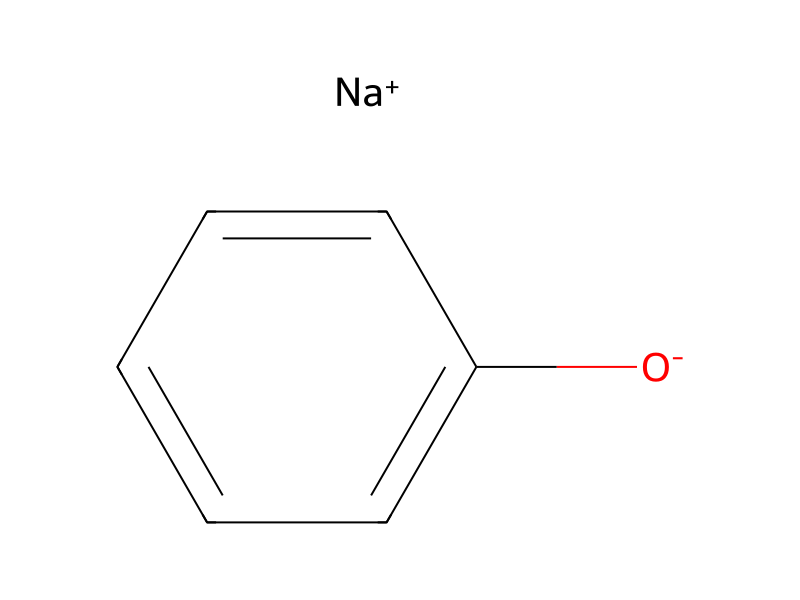
Phenolate Sodium → 1-Chloro-2-(1-ethylcyclopentyl)-2-phenoxyethylene
Reaction equation

[C:1]1([O-:7])[CH:6]=[CH:5][CH:4]=[CH:3][CH:2]=1.[Na+].[Cl:9][C:10](Cl)=[CH:11][C:12]1([CH2:17][CH3:18])[CH2:16][CH2:15][CH2:14][CH2:13]1>CN1CCCC1=O.C(Cl)Cl>[Cl:9][CH:10]=[C:11]([C:12]1([CH2:17][CH3:18])[CH2:16][CH2:15][CH2:14][CH2:13]1)[O:7][C:1]1[CH:6]=[CH:5][CH:4]=[CH:3][CH:2]=1Participants
5




Conditions
- Temperature
- 210 °C
Procedure
140 g (4.2 mol) of sodium phenolate in 500 ml of N-methylpyrrolidone were heated to 200° C. 116 g (0.6 mol) of 1-(2,2-dichlorovinyl)-1-ethyl-cyclopentane were added dropwise so slowly that the reaction temperature did not fall below 195° C. The mixture was then stirred for a further hour at 210° C. After the mixture had cooled, it was diluted with methylene chloride and extracted several times by shaking with 2N sodium hydroxide solution. The organic phase, which had been dried over sodium sulphate, was concentrated in vacuo, and the residue was fractionated. 132 g (88% of theory) of 1-chloro-2-(1-ethylcyclopentyl)-2-phenoxy-ethylene of boiling point 115° to 125° C./0.1 mm Hg were obtained. ##STR21##
Workup
- customdid not fall below 195° C
- temperatureAfter the mixture had cooled
- extractionextracted several times
- stirringby shaking with 2N sodium hydroxide solution
- dry with materialThe organic phase, which had been dried over sodium sulphate
- concentrationwas concentrated in vacuo
Sources & evidence
- ORD record
- ord-9f4e914190a54fa7bb7f903ccc869e5b
- Source dataset
- uspto-grants-1991_04
- Patent number
- US05010208
Reaction notes
Loading…