Hydrochloric Acid → HCID 19818793, compound
Reaction equation

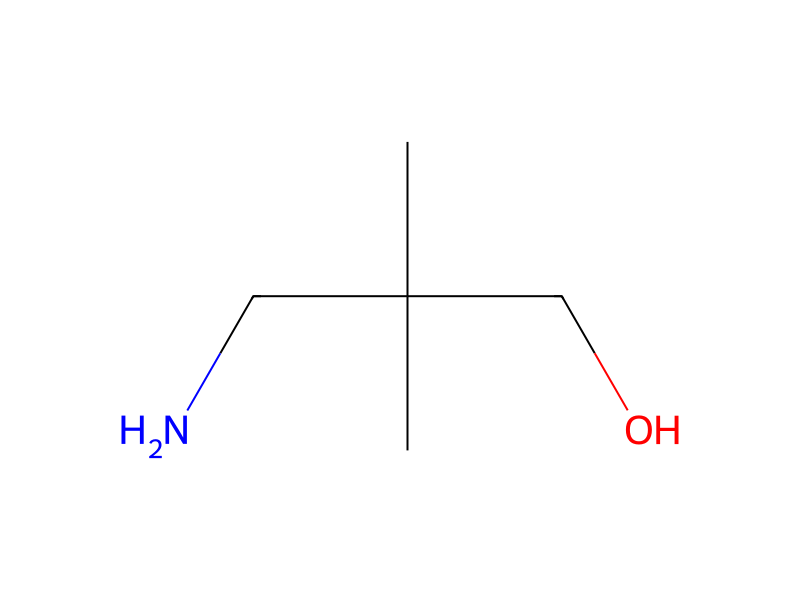
Cl[C:2]1[C:15]2[C:14](=[O:16])[C:13]3[C:8](=[CH:9][CH:10]=[CH:11][C:12]=3Cl)[C:7](=[O:18])[C:6]=2[CH:5]=[CH:4][CH:3]=1.[NH2:19][CH2:20][C:21]([CH3:25])([CH3:24])[CH2:22][OH:23].Cl>C(OCCO)C>[OH:23][CH2:22][C:21]([CH3:25])([CH3:24])[CH2:20][NH:19][C:2]1[C:15]2[C:14](=[O:16])[C:13]3[C:8](=[CH:9][CH:10]=[CH:11][C:12]=3[NH:19][CH2:20][C:21]([CH3:25])([CH3:24])[CH2:22][OH:23])[C:7](=[O:18])[C:6]=2[CH:5]=[CH:4][CH:3]=1Participants
Reactant 3


Product 1

Reagents, catalysts & solvents 1

Conditions
- Temperature
- 130 °C
Procedure
A mixture of 1,8-dichloroanthraquinone (13.8 g, 0.05 mol), 3-amino-2,2-dimethylpropanol (20.6 g, 0.20 mol) and 2-ethoxyethanol (100 mL) is heated at about 130° C. for 20 hours. The reaction mixture is drowned into water (1L) and the mixture is acidified with concentrated hydrochloric acid. The product, 1,8 -bis[(3-hydroxy-2,2-dimethylpropyl)amino]anthraquinone, is obtained in an essentially quantitative yield by filtering, washing with water and drying in air. Recrystallization from toluene, followed by filtration, washing with hexane and air drying gives 16.0 g of purified crystalline product. The product may be purified further by recrystallization from methanol. Thin layer chromatography shows that the product contains only one colored component and mass spectrometry analysis is consistent with 1,8-bis[(3-hydroxy-2,2-dimethylpropyl)amino]anthraquinone. The bluish-red product has an absorption maximum at 556 nm and an extinction coefficient (ε) of 12,228 in methylene chloride.
Sources & evidence
- ORD record
- ord-fdc13a55f8cd4913a73de2829c115f78
- Source dataset
- uspto-grants-1991_07
- Patent number
- US05032670
Reaction notes
Loading…