Hydrochloric Acid → Sodium Hypochlorite
Reaction equation

[OH-:1].[Na+:2].[Cl:3]Cl.Cl[O-].[Na+].[OH:8][C:9]1[N:17]=[CH:16][CH:15]=[CH:14][C:10]=1[C:11]([OH:13])=[O:12].Cl.[Cl:19]C1C(O)=NC=C(Cl)C=1>>[Cl:3][O-:1].[Na+:2].[Cl:19][C:15]1[CH:14]=[C:10]([C:11]([OH:13])=[O:12])[C:9]([OH:8])=[N:17][CH:16]=1Participants



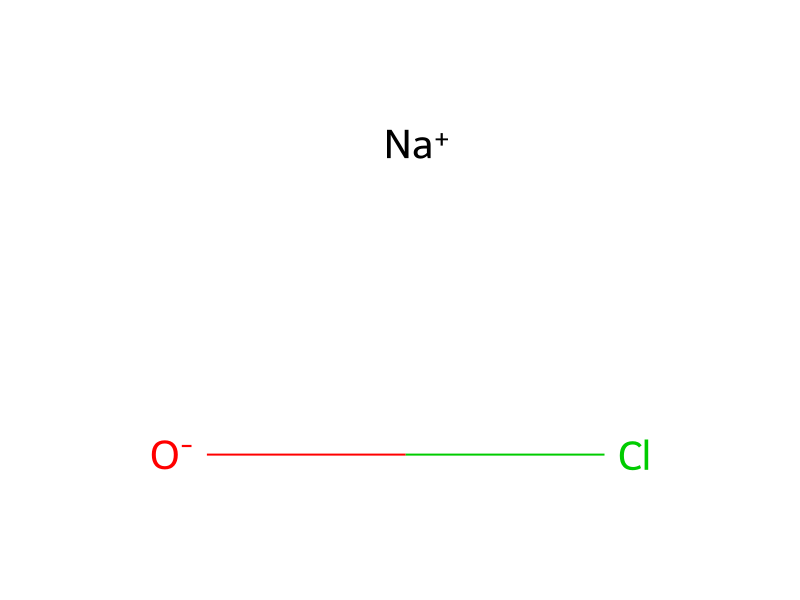


Procedure
Sodium hypochlorite solution was prepared by first adding 35.41 kg (442.6 mole) of 50% sodium hydroxide solution to 44 kg of flaked ice in a jacketed vessel having external circulating coolant; then adding 61.6 kg more flaked ice and introducing 7.87 kg (110.9 mole) of chlorine below the surface, all with agitation. To the sodium hypochlorite solution was added, portionwise, 15.0 kg of 98% purity (105.7 mole) 2-hydroxynicotinic acid (solids). The reaction temperature rose to 35° C. during the addition of the solids. Coolant was removed from the jacket and the mixture was stirred overnight at room temperature. A sample was withdrawn and acidified with concentrated hydrochloric acid to give precipitate which when analyzed by 1HNMR showed 75:25 ratio of title compound to starting 2-hydroxynicotinic acid. A second solution of sodium hypochlorite prepared as above from 10.57 kg of 50% sodium hydroxide solution (132.1 mole), 29.1 kg of ice and 3.65 kg (51.5 mole) of chlorine was added to the reaction mixture and the mixture was stirred overnight. This time a sample precipitated with concentrated hydrochloric acid showed no starting 2-hydroxynicotinic acid was present. Sodium bisulfite, 208 g (2.0 mole) was added to decompose unreacted excess sodium hypochlorite. Seven liters of isopropyl alcohol was then added to reduce expected foaming in the next step. The reaction mixture was added slowly to 41.48 kg (34.9 liters, 419.3 mole) of concentrated hydrochloric acid using external cooling to keep the mixture at 15°-25° C. pH of the mixture was 1.0. The slurry was filtered and the filter cake was washed with about 20 liters of water followed by 7 liters of acetone. The crystals were dried at 100° F. to a water content of about 5%; then milled and redried at 120° F. to a water content of 0.4%. The amount of crystals obtained was 17.42 kg (95.6% yield). 1HNMR analysis as described in Example 3 showed a trace of 3,5-dichloro-2-hydroxypyridine was present.
Workup
- additionthen adding 61.6 kg more flaked ice
- additionThe reaction temperature rose to 35° C. during the addition of the solids
- customCoolant was removed from the jacket
- customA sample was withdrawn
- customto give precipitate which when
- additionwas added to the reaction mixture
- stirringthe mixture was stirred overnight
- customThis time a sample precipitated with concentrated hydrochloric acid
- additionSodium bisulfite, 208 g (2.0 mole) was added
- additionSeven liters of isopropyl alcohol was then added
- temperatureexternal cooling
- customat 15°-25° C.
- filtrationThe slurry was filtered
- washthe filter cake was washed with about 20 liters of water
- dry with materialThe crystals were dried at 100° F. to a water content of about 5%
- customthen milled
- dry with materialredried at 120° F. to a water content of 0.4%
- customThe amount of crystals obtained
Sources & evidence
- ORD record
- ord-6cfd96253bbc4f7b9dc283b5f4bae973
- Source dataset
- uspto-grants-1990_10
- Patent number
- US04960896
Reaction notes
Loading…