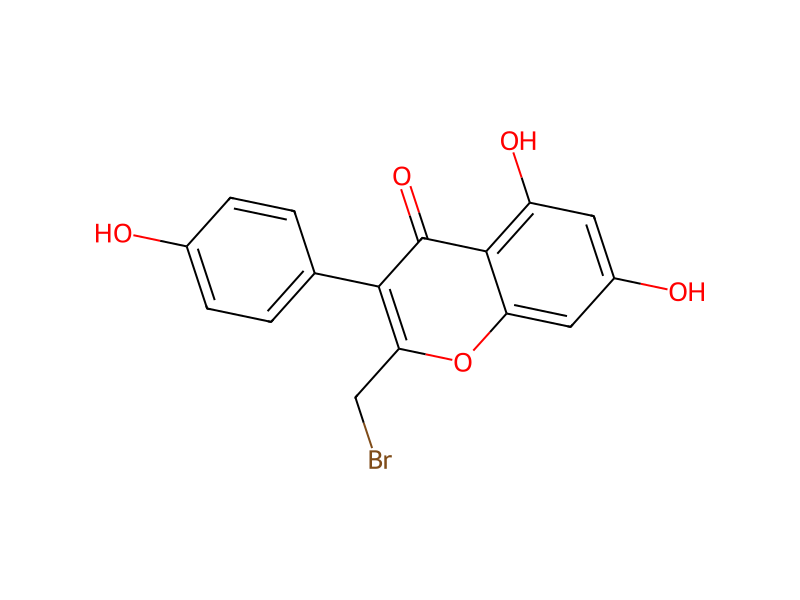
Hydrogen Bromide → 4',5,7-Trihydroxy-2-bromomethylisoflavone
Reaction equation

C([O:4][C:5]1[CH:31]=[CH:30][C:8]([C:9]2[C:18](=[O:19])[C:17]3[C:12](=[CH:13][C:14]([O:24]C(=O)C)=[CH:15][C:16]=3[O:20]C(=O)C)[O:11][C:10]=2[CH2:28][Br:29])=[CH:7][CH:6]=1)(=O)C.Br>>[OH:4][C:5]1[CH:31]=[CH:30][C:8]([C:9]2[C:18](=[O:19])[C:17]3[C:12](=[CH:13][C:14]([OH:24])=[CH:15][C:16]=3[OH:20])[O:11][C:10]=2[CH2:28][Br:29])=[CH:7][CH:6]=1Participants
3


Conditions
- Temperature
- 100 °C
Procedure
A mixture of 4',5,7-triacetoxy-2-bromomethylisoflavone (1 g) and 48% hydrobromic acid (7 ml) was heated at 100° C. for one hour, the reaction mixture was cooled with stirring, and the solid which separated out was collected by filtration and washed with water, giving 0.7 g of 4',5,7-trihydroxy-2-bromomethylisoflavone.
Workup
- temperaturethe reaction mixture was cooled
- customthe solid which separated out
- filtrationwas collected by filtration
- washwashed with water
Sources & evidence
- ORD record
- ord-9c454452f3c24f6292c8f35a12eccc2f
- Source dataset
- uspto-grants-1990_10
- Patent number
- US04960908
Reaction notes
Loading…