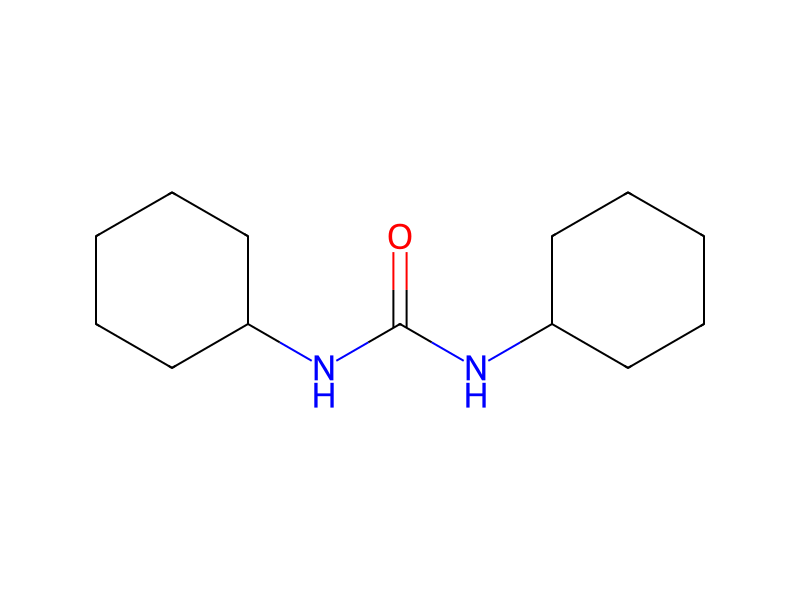
Dicyclohexylcarbodiimide → N,N'-Dicyclohexylurea
Reaction equation

Cl[C@@H](C(C)CC)C(O)=[O:4].[CH:10]1([N:16]=[C:17]=[N:18][CH:19]2[CH2:24][CH2:23][CH2:22][CH2:21][CH2:20]2)[CH2:15][CH2:14][CH2:13][CH2:12][CH2:11]1>CN(C)C1C=CN=CC=1.CCOCC>[CH:19]1([NH:18][C:17]([NH:16][CH:10]2[CH2:11][CH2:12][CH2:13][CH2:14][CH2:15]2)=[O:4])[CH2:24][CH2:23][CH2:22][CH2:21][CH2:20]1Participants
5
Reactant 2


Product 1
Reagents, catalysts & solvents 2


Procedure
While stirring, 1.5 g (0.01 moles) of (S)-2-chloro-3-methylpentanoic acid, 2.06 g (0.01 moles) of DCC, 0.12 g (0.001 moles) of 4-dimethylaminopyridine (DMAP) and an amount of 1-(4-n-alkoxy-benzoyloxy)-4-hydroxy-benzene corresponding to 0.01 moles are added to 50 mL of ether. The mixture is allowed to stand 2-3 days at room temperature. The N,N'-dicyclohexylurea formed is then filtered off with suction. The mother liquor is washed several times with water and dried over sodium sulfate. The solvent is then distilled off in a rotary evaporator and the residue is recrystallized several times from methanol.
Sources & evidence
- ORD record
- ord-dfca05eb29b540de9a5a69e285959389
- Source dataset
- uspto-grants-1990_10
- Patent number
- US04961876
Reaction notes
Loading…