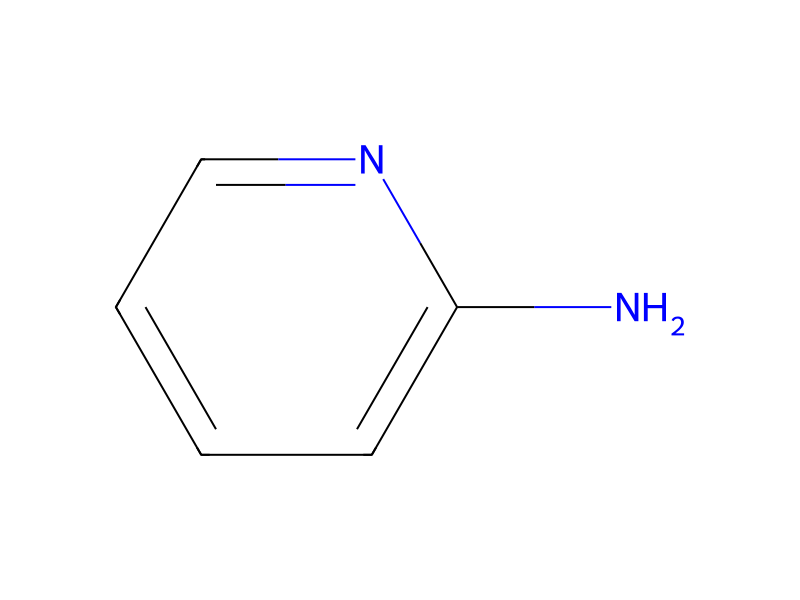
2-Aminopyridine → HCID 14368613, compound
Reaction equation

[H-].[Na+].[NH2:3][C:4]1[CH:9]=[CH:8][CH:7]=[CH:6][N:5]=1.[OH:10][C:11]1[C:20]2[C:15](=[CH:16][CH:17]=[CH:18][CH:19]=2)[C:14]([C:21]2[CH:26]=[CH:25][CH:24]=[CH:23][CH:22]=2)=[N:13][C:12]=1[C:27](OCC)=[O:28]>C1C=CC=CC=1>[OH:10][C:11]1[C:20]2[C:15](=[CH:16][CH:17]=[CH:18][CH:19]=2)[C:14]([C:21]2[CH:22]=[CH:23][CH:24]=[CH:25][CH:26]=2)=[N:13][C:12]=1[C:27]([NH:3][C:4]1[CH:9]=[CH:8][CH:7]=[CH:6][N:5]=1)=[O:28]Participants
5
Reactant 3


Product 1

Reagents, catalysts & solvents 1

Procedure
To a stirred slurry of 1.14 g of sodium hydride (as a 50% oil dispersion) in 100 ml of benzene was added 2.25 g of 2-aminopyridine. After stirring at room temperature for 15 minutes the slurry was treated with a solution of 2.25 g of 4-hydroxy-1-phenyl-3-isoquinolinecarboxylic acid, ethyl ester in 50 ml of benzene. After refluxing for one hour, the reaction mixture was cooled to room temperature, quenched with water, and extracted with three 100 ml aliquots of hot tetrahydrofuran. The organic layer was dried over magnesium sulfate, filtered, and evaporated to yield 1.7 g (65%) of 4-hydroxy-1-phenyl-N-(2-pyridyl)-3-isoquinolinecarboxamide. Recrystallization from dichloromethane afforded the analytical sample, m.p. 228°-230° C.
Workup
- temperatureAfter refluxing for one hour
- temperaturethe reaction mixture was cooled to room temperature
- customquenched with water
- extractionextracted with three 100 ml aliquots of hot tetrahydrofuran
- dry with materialThe organic layer was dried over magnesium sulfate
- filtrationfiltered
- customevaporated
Sources & evidence
- ORD record
- ord-9adba1608db940079b4dba949623167f
- Source dataset
- uspto-grants-1990_10
- Patent number
- US04966906
Reaction notes
Loading…