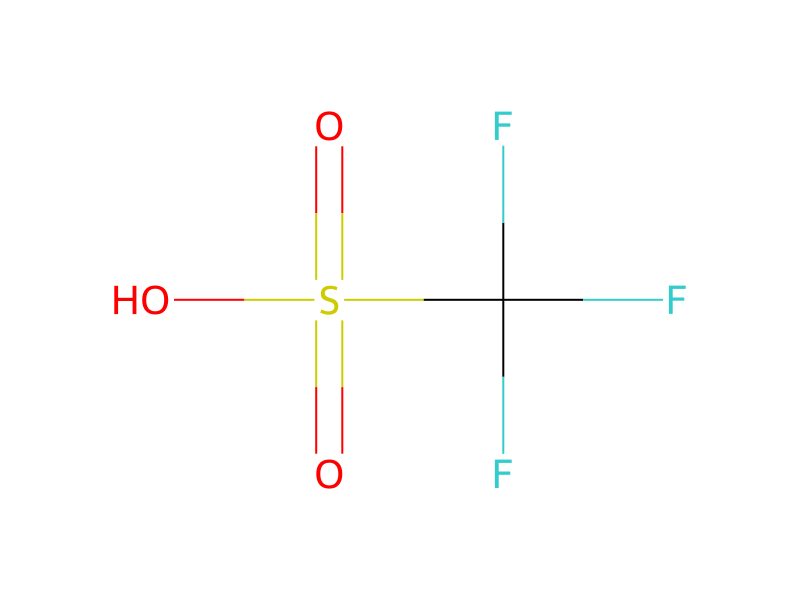
Trifluoromethanesulfonic acid → Benzene, (1-cyclopropylethyl)-
Reaction equation

[CH:1]1([C:4]([C:6]2[CH:11]=[CH:10][CH:9]=[CH:8][CH:7]=2)=[CH2:5])[CH2:3][CH2:2]1.C(S(O)(=O)=O)(F)(F)F>>[CH:1]1([CH:4]([C:6]2[CH:7]=[CH:8][CH:9]=[CH:10][CH:11]=2)[CH3:5])[CH2:3][CH2:2]1Participants


Procedure
A solution of α-cyclopropylstyrene (5 microliters, 0.033 mmol) and (C5H5)(CO)3MoH (24 mg, 0.097 mmole) in dichloromethane-d2 was treated at room temperature with CF3SO3H (3 microliters, 0.034 mmol). A color change indicated an immediate reaction and an 1H NMR after 5 minutes showed that α-cyclopropyl-ethylbenzene (58% yield) was the major product. This indicates that hydrogenation of the carbon-carbon double bond is favored over cleavage of the cyclopropyl group. Additional CF3SO3H (5 microliters, 0.056 mmol) was added. NMR after one hour showed the major product to be 2-phenylpentane (Ca 57%). Two other products, 3-phenylpentane and β-methyl-butylbenzene, were observed in approximate yields of 14% and 7% respectively. These two products are formed due to rearrangement of the intermediate carbocation which is formed from the reaction of CF3SO3H with α-cyclopropyl-ethylbenzene.
Workup
- customan immediate reaction
Sources & evidence
- ORD record
- ord-c860998df96e482c8fa50ba282263ac5
- Source dataset
- uspto-grants-1990_10
- Patent number
- US04967031
Reaction notes
Loading…