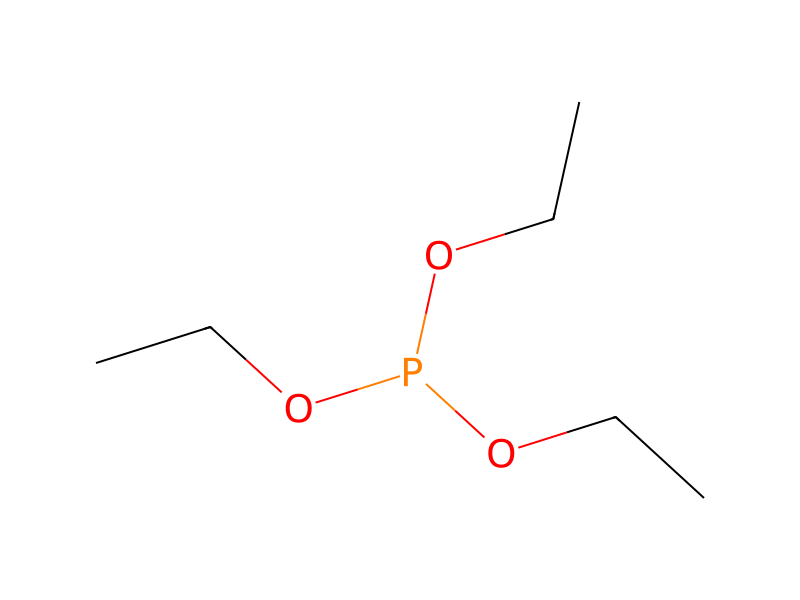
Triethyl phosphite → HCID 178517230, compound
Reaction equation

[Cl:1][C:2]1[C:3]2[C:4](=[N+:14]([O-])[O:15][N:16]=2)[C:5]2[N:6]=[C:7]([OH:13])[C:8]([OH:12])=[N:9][C:10]=2[CH:11]=1.P(OCC)(OCC)OCC>C(O)C.CN(C)C=O>[Cl:1][C:2]1[C:3]2[C:4](=[N:14][O:15][N:16]=2)[C:5]2[N:6]=[C:7]([OH:13])[C:8]([OH:12])=[N:9][C:10]=2[CH:11]=1Participants
5
Reactant 2

Product 1

Reagents, catalysts & solvents 2


Procedure
To a solution of 0,6 g (2,4 mmol) 4-chloro-7,8-dihydroxy-1,2,5-oxadiazolo(3,4-f)quinoxaline-1-oxide in a mixture of 14 ml ethanol and 3 ml dimethylformamide was added 0.9 ml (5,3 mmol) triethyl phosphite. The mixture was refluxed for 4 h, and then evaporated in vacuo. The residue was stirred with water and then with ether-ethyl acetate (5:1) to give 0,4 g (71%) 4-chloro-7,8-dihydroxy-1,2,5-oxadiazolo-(3,4-f)quinoxaline, m.p.>300° C. NMR (DMSO-d6 +D2O): 7.40 (lH,s).
Workup
- temperatureThe mixture was refluxed for 4 h
- customevaporated in vacuo
Sources & evidence
- ORD record
- ord-f4ea48ee47724975903f55b8cbfa363a
- Source dataset
- uspto-grants-1992_01
- Patent number
- US05079250
Reaction notes
Loading…