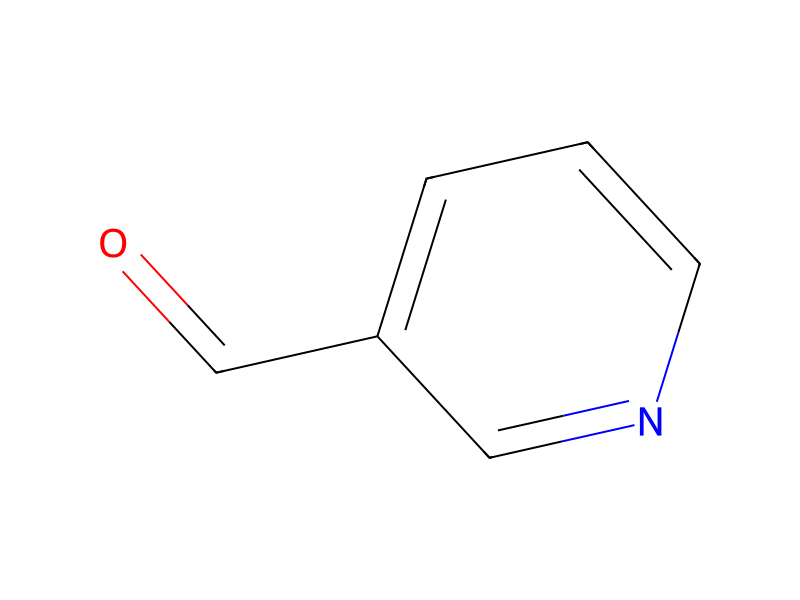
3-Pyridinecarboxaldehyde → HCID 15644566, compound
Reaction equation

[N+](C1C=CC(CP(=O)(OCC)OCC)=CC=1)([O-])=O.N1C=CC=C(C=O)C=1.[N+:27]([C:30]1[CH:43]=[CH:42][C:33]([CH:34]=[CH:35][C:36]2[CH:37]=[N:38][CH:39]=[CH:40][CH:41]=2)=[CH:32][CH:31]=1)([O-])=O>>[N:38]1[CH:39]=[CH:40][CH:41]=[C:36]([CH2:35][CH2:34][C:33]2[CH:32]=[CH:31][C:30]([NH2:27])=[CH:43][CH:42]=2)[CH:37]=1Participants


Procedure
Anilines with other sidechains will be readily prepared by a person having ordinary skill in the art having regard to that skill and this disclosure, and will be usable in the syntheses of Reaction Scheme 4. For example, diethyl (4-nitrobenzyl)phosphonate was reacted in a Wittig reaction with pyridin-3-carboxaldehyde and the resulting 3-(4-nitrostyryl)pyridine hydrogenated to give 4-[2-(pyridin-3-yl)ethyl]benzenamine, used to synthesize compound 99A, and the anilines used to synthesize compounds 97A and 98A were similarly prepared; 4-nitrobenzaldehyde was reacted with glyoxal and ammonia to give 2-(4-nitrophenyl)-1H-imidazole, which was N-methylated with methyl iodide and then reduced with stannous chloride to give 4-(1-methyl-1H-imidazol-2-yl)benzenamine, used to synthesize compound 106A; 2-fluoro-4-nitrobenzoic acid was converted to the corresponding benzoyl chloride with oxalyl chloride, then reacted with 3-(morpholin-4-yl)propan-1-amine and reduced to give 4-amino-2-fluoro-N-[3-(morpholin-4-yl)propyl]benzamide, used to synthesize compound 50A; and 4-nitrobenzenesulfonyl chloride was reacted with 2-(morpholin-4-yl)ethan-1-amine and then reduced with stannous chloride to give 4-amino-N[2-(morpholin-4-yl)ethyl]benzenesulfonamide, used to synthesize compound 128A.
Workup
- customthis disclosure, and will be usable in the syntheses of Reaction Scheme 4
Sources & evidence
- ORD record
- ord-915b48aff374420c928cee344e645a05
- Source dataset
- uspto-grants-2012_03
- Patent number
- US08129396B2
Reaction notes
Loading…