Formaldehyde → 4-(Morpholin-4-ylmethyl)-1H-pyrrole-2-carbaldehyde
Reaction equation

[NH:1]1[CH2:6][CH2:5][O:4][CH2:3][CH2:2]1.[NH:7]1[CH:11]=[CH:10][CH:9]=[C:8]1[CH:12]=[O:13].[CH2:14]=O>C(O)(=O)C>[N:1]1([CH2:14][C:10]2[CH:9]=[C:8]([CH:12]=[O:13])[NH:7][CH:11]=2)[CH2:6][CH2:5][O:4][CH2:3][CH2:2]1Participants
Reactant 3


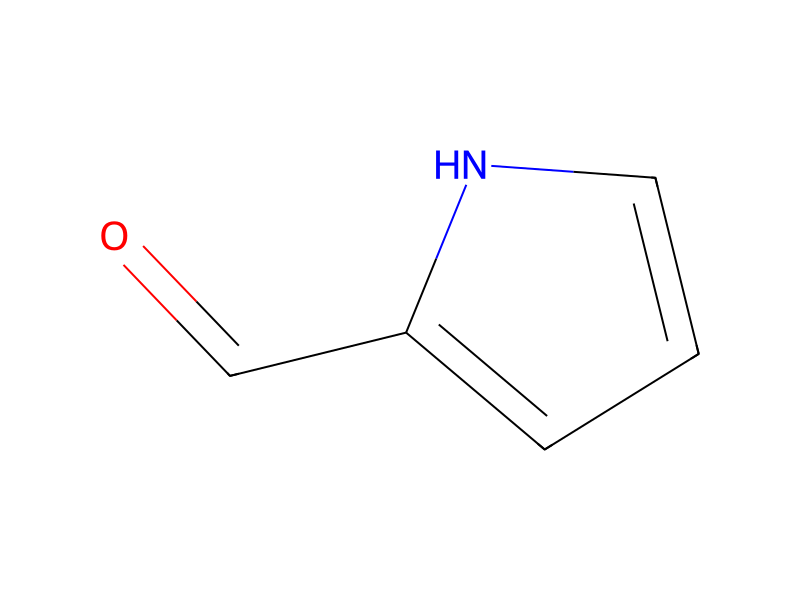
Product 1

Reagents, catalysts & solvents 1

Procedure
To a solution of morpholine (0.38 mole) in acetic acid (120 ml) at 0° C. there is added a solution of 1H-pyrrole-2-carbaldehyde (0.32 mole) in acetic acid (100 ml). Formaldehyde (37% aq., 26 ml) is then added dropwise. The reaction mixture is then stirred for 65 hours at ambient temperature. The mixture is concentrated (about 50 ml) and cooled in an ice bath. The pH of the solution is made alkaline (pH=12) using 20% aqueous sodium hydroxide solution. The product is extracted with dichloromethane (DCM) (3×250 ml). The organic phases are combined. The organic phase obtained is washed with saturated aqueous NaCl solution, dried over sodium sulphate, filtered and evaporated to dryness. The residue obtained (oil) is purified on silica gel (SiO2, gradient DCM/MeOH) to yield the title product.
Workup
- concentrationThe mixture is concentrated (about 50 ml)
- temperaturecooled in an ice bath
- extractionThe product is extracted with dichloromethane (DCM) (3×250 ml)
- customThe organic phase obtained
- washis washed with saturated aqueous NaCl solution
- dry with materialdried over sodium sulphate
- filtrationfiltered
- customevaporated to dryness
- customThe residue obtained (oil)
- customis purified on silica gel (SiO2, gradient DCM/MeOH)
Sources & evidence
- ORD record
- ord-29e20ab5032c4a32ba4745b498d80824
- Source dataset
- uspto-grants-2012_03
- Patent number
- US08133889B2
Reaction notes
Loading…