Diiodomethane → 5-(Naphthalen-2-yl)bicyclo[3.1.0]hexan-2-ol
Reaction equation

[CH:1]1[C:10]2[C:5](=[CH:6][CH:7]=[CH:8][CH:9]=2)[CH:4]=[CH:3][C:2]=1[C:11]1[CH2:15][CH2:14][CH:13]([OH:16])[CH:12]=1.[CH2:17]([Zn]CC)C.ICI>ClCCl>[CH:1]1[C:10]2[C:5](=[CH:6][CH:7]=[CH:8][CH:9]=2)[CH:4]=[CH:3][C:2]=1[C:11]12[CH2:17][CH:12]1[CH:13]([OH:16])[CH2:14][CH2:15]2Participants
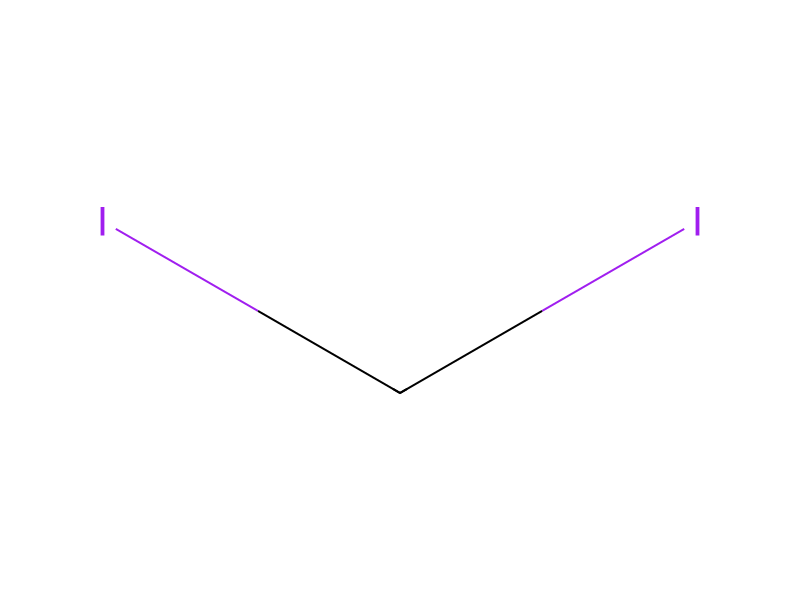
Reactant 3


Product 1

Reagents, catalysts & solvents 1

Conditions
- Temperature
- 0 °C
Procedure
A solution of 3-(naphthalen-2-yl)cyclopent-2-enol (2.32 g, 11.0 mmol) in dichloromethane (80 mL) was treated with diethylzinc (1.0 M in hexane; 54.6 mL, 54.6 mmol, 5.0 eq.). After 10 min, the reaction mixture was cooled to 0° C., treated with a solution of diiodomethane (4.51 mL, 55.5 mmol, 5.0 eq) in dichloromethane (20 mL) dropwise over 10 min and allowed to warm to ambient temperature. After 2 h, the reaction mixture was quenched with saturated aqueous ammonium chloride (40 mL). The reaction mixture was extracted with dichloromethane (3×40 mL). The combined organic phases were dried over magnesium sulphate, concentrated in vacuo to afford the desired compound in a quantitative yield as a white solid which was not further purified. 1H NMR (400 MHz, CDCl3) δ ppm 0.94-1.01 (1H, m, CH), 1.27-1.41 (2H, m, CH2), 1.98-2.02 (1H, m, CH), 2.10-2.20 (2H, m, CH2), 2.24-2.33 (1H, m, CH), 4.71-4.80 (1H, m, CH), 7.23-7.26 (1H, m, ArH), 7.40-7.48 (2H, m, ArH), 7.64 (1H, s, ArH), 7.72-7.84 (3H, m, ArH).
Workup
- temperatureto warm to ambient temperature
- waitAfter 2 h
- customthe reaction mixture was quenched with saturated aqueous ammonium chloride (40 mL)
- extractionThe reaction mixture was extracted with dichloromethane (3×40 mL)
- dry with materialThe combined organic phases were dried over magnesium sulphate
- concentrationconcentrated in vacuo
Sources & evidence
- ORD record
- ord-c5d4eed651e5439cb94430c0ce657987
- Source dataset
- uspto-grants-2012_03
- Patent number
- US08138377B2
Reaction notes
Loading…