Quinoline → 2-Chloro-3-nitro-5-(trifluoromethyl)pyridine
Reaction equation

[N+:1]([C:4]1[C:5](O)=[N:6][CH:7]=[C:8]([C:10]([F:13])([F:12])[F:11])[CH:9]=1)([O-:3])=[O:2].N1C2C(=CC=CC=2)C=CC=1.P(Cl)(Cl)([Cl:27])=O.[OH-].[Na+]>>[Cl:27][C:5]1[C:4]([N+:1]([O-:3])=[O:2])=[CH:9][C:8]([C:10]([F:13])([F:12])[F:11])=[CH:7][N:6]=1Participants
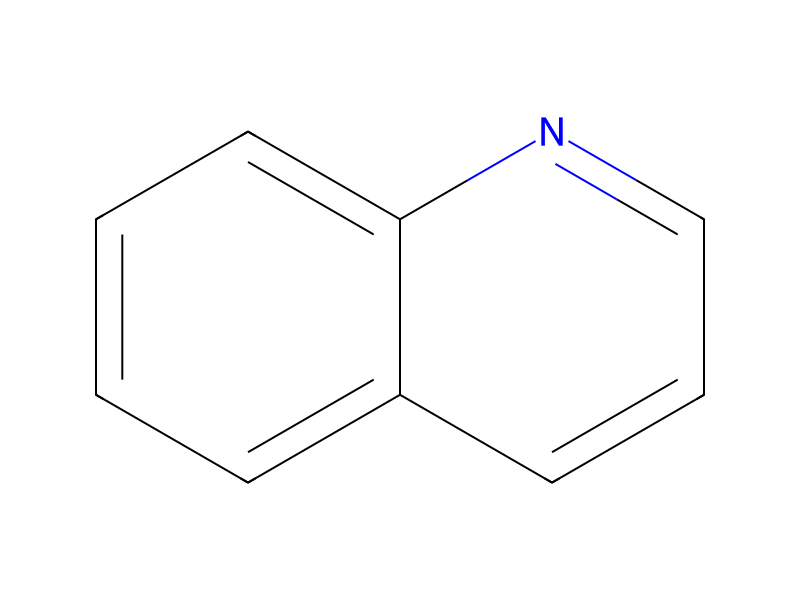




Procedure
3-nitro-5-(trifluoromethyl)pyridin-2-ol (6.80 g, 32.7 mmol) and quinoline (2.72 g, 21.06 mmol) were combined in a 200 mL round-bottom flask with an oversized magnetic stir bar. The assembly was cooled with an RT water bath. Phosphorus oxychloride (4.07 ml, 43.7 mmol) was cautiously added with vigorous stirring. After 5 mm, the resulting gel would no longer stir. The apparatus was equipped with a reflux condenser and was transferred to a 120° C. oil bath. The gel quickly melted and stirring resumed with gentle refluxing. After 3 h, the mixture was cooled to RT and added portion wise to ice water with vigorous stirring. Sodium hydroxide was added to adjust the alkalinity to pH 8-9 and the mixture was extracted with EtOAc (2×100 mL) and CH2Cl2 (2×100 mL). The combined organics were dried (MgSO4), concentrated in vacuo and chromatographed (EtOAc/CH2Cl2) provided 2-chloro-3-nitro-5-(trifluoromethyl)pyridine (6.65 g, 90% yield) as a yellow liquid. 1H NMR (400 MHz, DMSO-d6): δ 9.21 (m, 1 H), 9.09 (m, 1 H).
Workup
- customThe apparatus was equipped with a reflux condenser
- customwas transferred to a 120° C.
- stirringstirring
- temperaturethe mixture was cooled to RT
- extractionthe mixture was extracted with EtOAc (2×100 mL) and CH2Cl2 (2×100 mL)
- dry with materialThe combined organics were dried (MgSO4)
- concentrationconcentrated in vacuo
- customchromatographed (EtOAc/CH2Cl2)
Sources & evidence
- ORD record
- ord-5fcd4a82e4004b18aa30e0d715fefd57
- Source dataset
- uspto-grants-2012_03
- Patent number
- US08143293B2
Reaction notes
Loading…