4-Chlorophenyl Isocyanate → HCID 20555444, compound
Reaction equation

C[NH:2][S:3]([CH2:6]Cl)(=[O:5])=[O:4].[Cl:8][C:9]1[CH:14]=[CH:13][C:12]([N:15]=[C:16]=[O:17])=[CH:11][CH:10]=1.C(N(CC)CC)C>CCOCC>[Cl:8][C:9]1[CH:14]=[CH:13][C:12]([N:15]2[CH2:6][S:3](=[O:5])(=[O:4])[NH:2][C:16]2=[O:17])=[CH:11][CH:10]=1Participants
Reactant 3
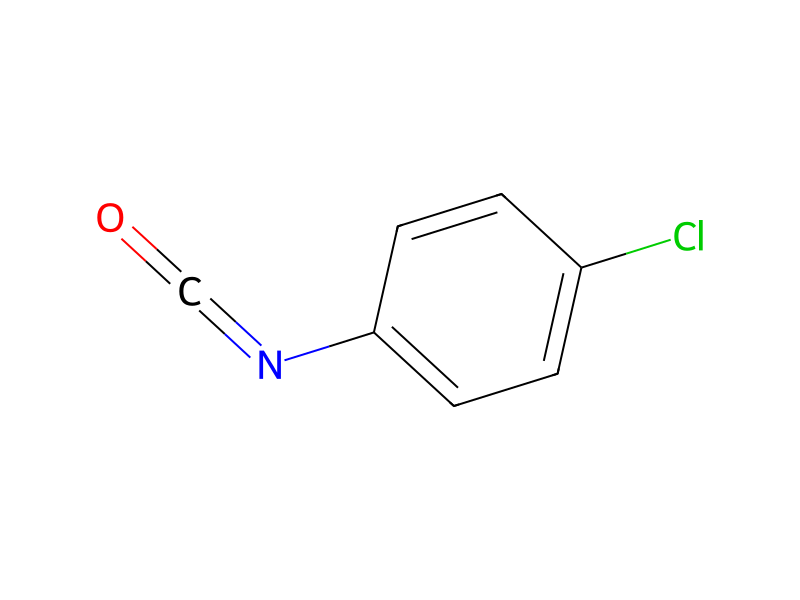


Product 1

Reagents, catalysts & solvents 1

Procedure
A 50-ml flask was charged with 5.0 grams (0.035 mol) of N-methyl chloromethane sulfonyl chloride (from Example 1) and 5.3 grams (0.035 mol) of p-chlorophenylisocyanate. Then 3 ml of triethylamine were added. There was an exothermic reaction, and the mixture turned solid. After standing for 3/4 hour at 25° C., ether was added to form a slurry. This slurry was filtered to give a white solid which was reslurried in ether, filtered and dried to give 2.7 grams of 4-p-chlorophenyl-1,2,4-thiadiazolidine-1,1,3-trione having a melting point of 155°-157° C. Analysis for C9H9ClN2O3S: S, 12.3%; Cl, 13.6%. Found, S, 12.4%; Cl, 13.7%. The infrared spectra had strong absorption at 1720, 1485, 1435, 1370, 1340, 1280, 1255, and 1145 cm-1. The NMR spectra in 6D-dimethylsulfoxide had major peaks at 7.7 (4H), 5.6 (2H), and 3.3 (3H) ppm, and minor peaks at 4.0 and 2.8 ppm.
Workup
- customan exothermic reaction
- waitAfter standing for 3/4 hour at 25° C.
- customto form a slurry
- filtrationThis slurry was filtered
- customto give a white solid which
- filtrationfiltered
- customdried
Sources & evidence
- ORD record
- ord-911aae383b404bfe9c135f98b535b654
- Source dataset
- uspto-grants-1982_01
- Patent number
- US04309209
Reaction notes
Loading…