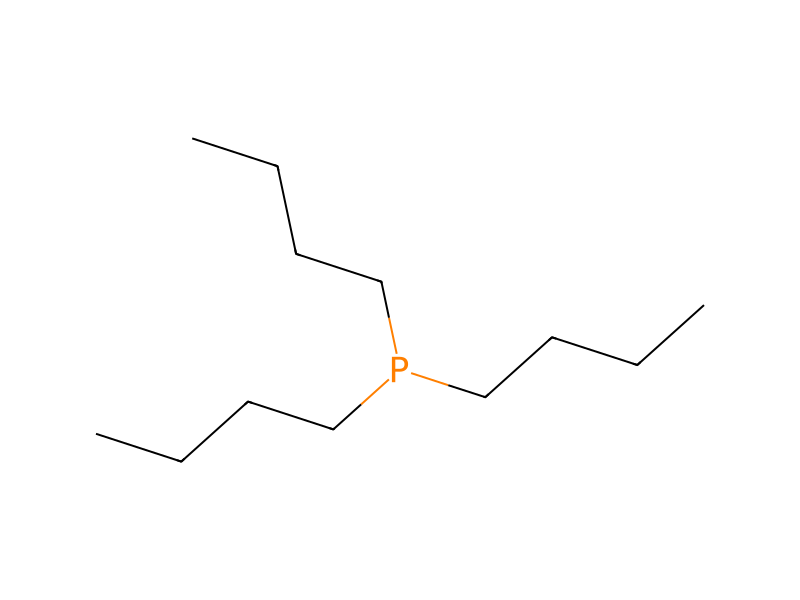
Tributylphosphine → HCID 86738217, compound
Reaction equation

C(P(CCCC)CCCC)CCC.[CH2:14]([CH:17]([CH2:20][CH2:21][CH3:22])[CH:18]=[O:19])[CH2:15][CH3:16].[CH2:23]([CH:25]([CH2:28][CH2:29][CH2:30][CH3:31])[CH:26]=[O:27])[CH3:24]>>[CH2:14]([CH:17]([CH2:20][CH2:21][CH3:22])[CH:18]=[O:19])[CH2:15][CH3:16].[CH2:23]([CH:25]([CH2:28][CH2:29][CH2:30][CH3:31])[CH:26]=[O:27])[CH3:24]Participants
4


Conditions
- Temperature
- 130 °C
Procedure
Into an autoclave are charged 294.6 g (=420 ml, 3 moles) of heptene-3, 50 ppm of Rh (based on heptene-3) in the form of RhCl3, and 2.8 g of tributyl phosphine (molar ratio of Rh:phosphine=1:100). A pressure of 150 bars is adjusted by introducing CO and H2 (molar ratio, 1:1). Thereafter, the temperature is increased to 130° C. and the pressure to 290 bars. After 3 hours, the olefin is reacted quantitatively. As is shown by the analysis by gas chromatography, the reaction product contains 2-propyl pentanal and 2-ethyl hexanal in a ratio of about 75:25. The yield (2-propyl pentanal+2-ethyl hexanal) is 346 g. The hydroformylation product is directly oxidized after flash distillation.
Workup
- additionby introducing CO and H2 (molar ratio, 1:1)
Sources & evidence
- ORD record
- ord-407009479ac842afb28349e0c39310f6
- Source dataset
- uspto-grants-1982_01
- Patent number
- US04311854
Reaction notes
Loading…