Hydrochloric Acid → 2-Bromo-1,3-thiazole-4-carboxylic acid
Reaction equation

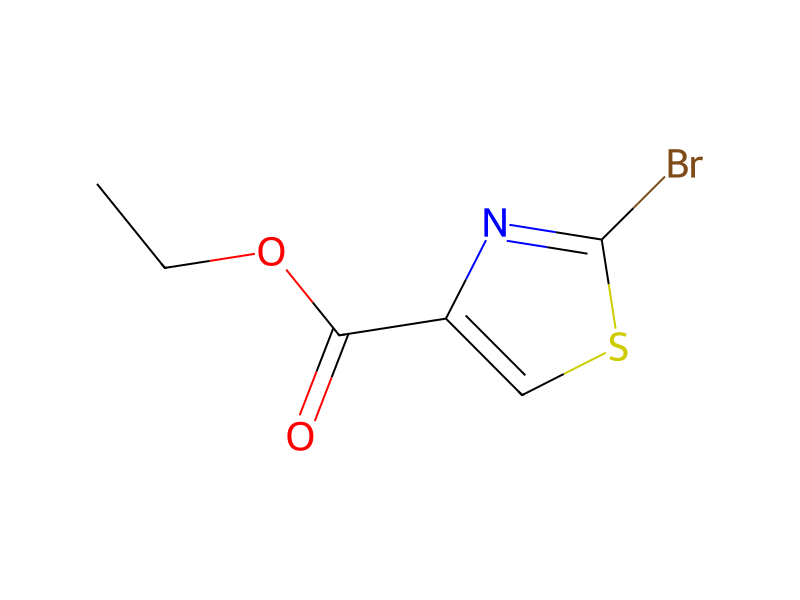
C([O:3][C:4]([C:6]1[N:7]=[C:8]([Br:11])[S:9][CH:10]=1)=[O:5])C.Cl>[OH-].[Na+]>[Br:11][C:8]1[S:9][CH:10]=[C:6]([C:4]([OH:5])=[O:3])[N:7]=1Participants
4
Reactant 2

Product 1

Reagents, catalysts & solvents 1

Procedure
To a 100 mL 24/40 round bottom flask was charged 3.25 g (13.8 mmol) of 2-bromo-4-thiazolecarboxylic acid ethyl ester (Helv. Chim. Acta, 1942, 25, 1073) dissolved in 20 mL of 1N sodium hydroxide. The reaction was stirred at room temperature for 3 h, cooled down in an ice bath and acidified to pH 2 with SN hydrochloric acid. The white precipitate was filtered, washed with 20 mL cold water, and dried in a vacuum oven to give 2.7 g (94%) of 2-bromo-4-thiazolecarboxylic acid. m.p. 227-229° C., Rf =0.16 (20% methanol/chloroform). 1H NMR (300 MHz, DMSO-d6) δ 8.43 (s, 1H).
Workup
- temperaturecooled down in an ice bath
- filtrationThe white precipitate was filtered
- washwashed with 20 mL cold water
- customdried in a vacuum oven
Sources & evidence
- ORD record
- ord-b9ad7fbef84348f590ab16def957faf5
- Source dataset
- uspto-grants-2000_05
- Patent number
- US06066639
Reaction notes
Loading…