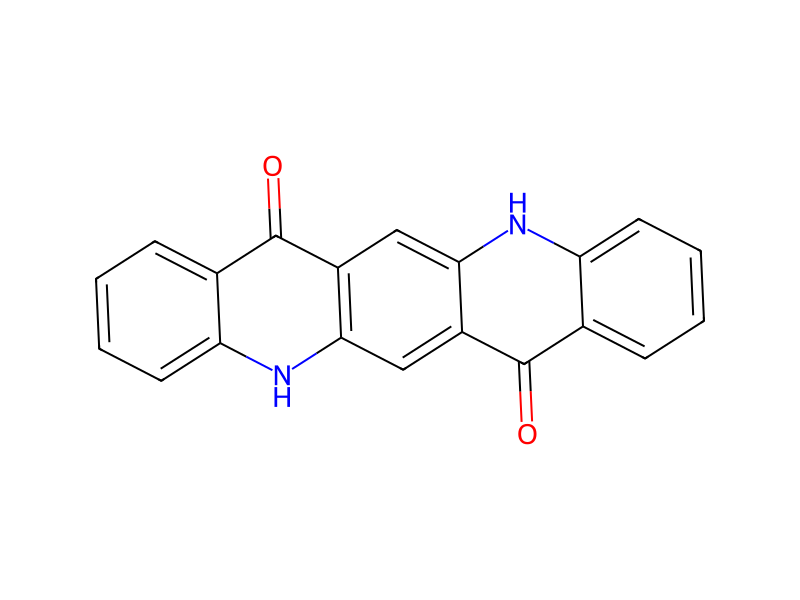
2,5-Dianilinoterephthalic acid → Quinacridone
Reaction equation

[NH:1]([C:8]1[CH:16]=[C:15]([C:17](O)=[O:18])[C:14]([NH:20][C:21]2[CH:26]=[CH:25][CH:24]=[CH:23][CH:22]=2)=[CH:13][C:9]=1[C:10](O)=[O:11])[C:2]1[CH:7]=[CH:6][CH:5]=[CH:4][CH:3]=1>O>[CH:24]1[CH:25]=[C:26]2[C:17]([C:15]3[C:14]([NH:20][C:21]2=[CH:22][CH:23]=1)=[CH:13][C:9]1[C:10]([C:7]2[C:2]([NH:1][C:8]=1[CH:16]=3)=[CH:3][CH:4]=[CH:5][CH:6]=2)=[O:11])=[O:18]Participants
3
Reactant 1

Product 1
Reagents, catalysts & solvents 1

Conditions
- Temperature
- 120 °C
Procedure
Into a 3/4 inch (about 20 mm) single screw extruder having a ratio of length to diameter of about 30:1 and three zones heated at 90° C., 120° C., and 180° C. were introduced 11.7 g per minute of 2,5-dianilinoterephthalic acid and 27.2 g per minute of polyphosphoric acid (117.7% phosphoric acid). The resultant mass was introduced into water. The resultant solid was collected by filtration and reslurried in water containing sodium hydroxide (pH greater than 10). The slurry was heated at 90 to 95° C. for one hour, then collected by filtration, washed until free of alkali, and dried to give an 85% yield of quinacridone (91.3% purity).
Workup
- filtrationThe resultant solid was collected by filtration
- additioncontaining sodium hydroxide (pH greater than 10)
- temperatureThe slurry was heated at 90 to 95° C. for one hour
- filtrationcollected by filtration
- washwashed until free of alkali, and
- customdried
Sources & evidence
- ORD record
- ord-e2e20096910b44afa08045c4d97b8854
- Source dataset
- uspto-grants-2000_05
- Patent number
- US06068695
Reaction notes
Loading…