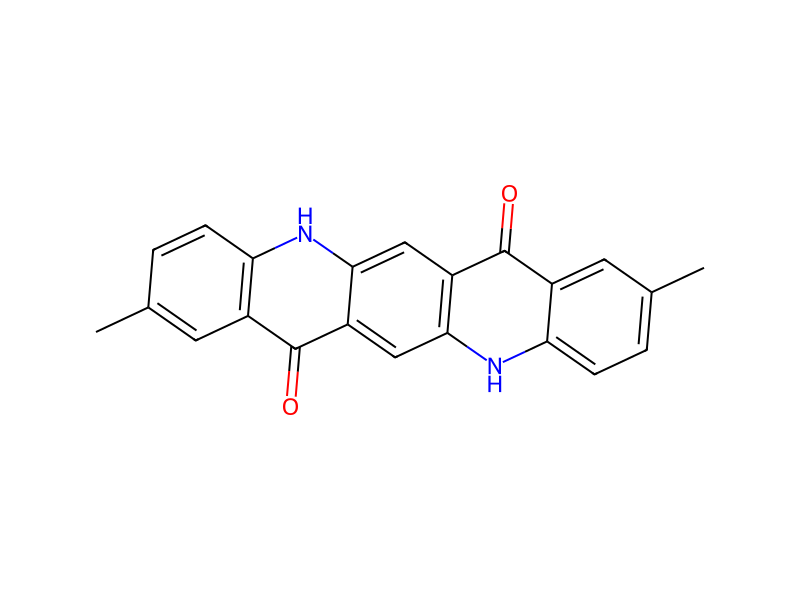
2,5-Di-p-toluidinoterephthalic acid → 5,12-Dihydro-2,9-dimethylquino(2,3-b)acridine-7,14-dione
Reaction equation

[CH3:1][C:2]1[CH:28]=[CH:27][C:5]([NH:6][C:7]2[CH:15]=[C:14]([C:16]([OH:18])=O)[C:13]([NH:19][C:20]3[CH:25]=[CH:24][C:23]([CH3:26])=[CH:22][CH:21]=3)=[CH:12][C:8]=2[C:9](O)=[O:10])=[CH:4][CH:3]=1>CO>[CH3:1][C:2]1[CH:28]=[CH:27][C:5]2[NH:6][C:7]3[C:8]([C:9](=[O:10])[C:4]=2[CH:3]=1)=[CH:12][C:13]1[NH:19][C:20]2[CH:25]=[CH:24][C:23]([CH3:26])=[CH:22][C:21]=2[C:16](=[O:18])[C:14]=1[CH:15]=3Participants
3
Reactant 1

Product 1
Reagents, catalysts & solvents 1

Conditions
- Temperature
- 85 °C
Procedure
Example 5 was repeated using 25 g per minute of 2,5-di(4-methylanilino)terephthalic acid and 51 g per minute of polyphosphoric acid at a processor temperature of 160° C., followed by drowning with 100 g per minute of methanol (initial temperature of 25° C.) heated to 85° C. 2,9-Dimethylquinacridone was obtained in greater than 95% yield.
Workup
- customat a processor temperature of 160° C.
- customtemperature of 25° C.
Sources & evidence
- ORD record
- ord-9cf659cb4c004cd68043a84e91b5d61d
- Source dataset
- uspto-grants-2000_05
- Patent number
- US06068695
Reaction notes
Loading…