Water → 9,10-Anthracenedione, 1,4-bis((3-chloro-2-hydroxypropyl)amino)-
Reaction equation

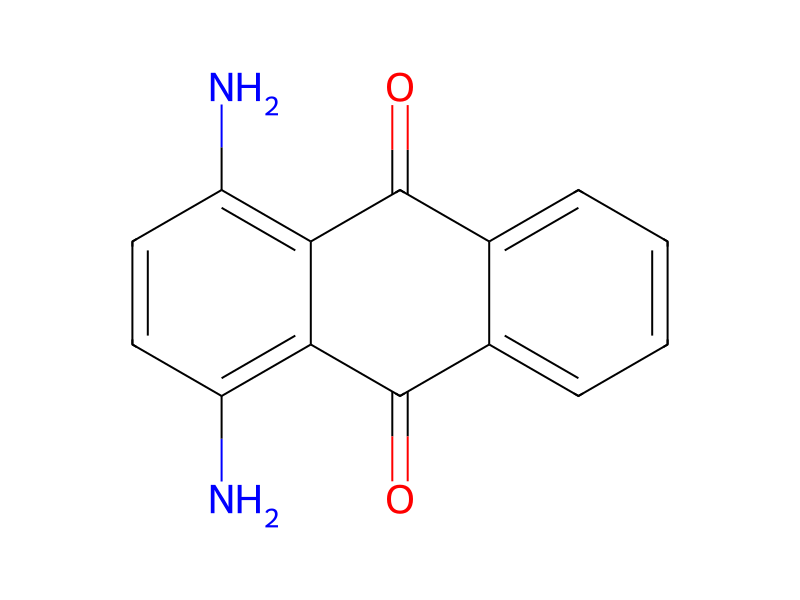
[NH2:1][C:2]1[C:15]2[C:14](=[O:16])[C:13]3[C:8](=[CH:9][CH:10]=[CH:11][CH:12]=3)[C:7](=[O:17])[C:6]=2[C:5]([NH2:18])=[CH:4][CH:3]=1.[OH2:19].[CH2:20]([CH:22]1[O:24][CH2:23]1)[Cl:21]>C(O)(=O)C>[Cl:21][CH2:20][CH:22]([OH:19])[CH2:23][NH:1][C:2]1[C:15]2[C:14](=[O:16])[C:13]3[C:8](=[CH:9][CH:10]=[CH:11][CH:12]=3)[C:7](=[O:17])[C:6]=2[C:5]([NH:18][CH2:23][CH:22]([OH:24])[CH2:20][Cl:21])=[CH:4][CH:3]=1Participants
Reactant 3


Product 1

Reagents, catalysts & solvents 1

Conditions
- Temperature
- 50 °C
Procedure
1,4-Diaminoanthraquinone (20.00 g, 0.084 mole) was slurried in 200 ml of glacial acetic acid containing 12 ml of water. This mixture was heated to 50° C. and treated with 8.0 ml of epichlorohydrin. The reaction temperature was raised to between 90° and 100° C. and the remaining 32 ml of epichlorohydrin was dripped in slowly during 3.5 hours while maintaining this temperature range. A total of 40 ml (0.511 mole) of epichlorohydrin was added to the reaction mixture. After addition was complete, the external heating source was removed and the reaction mixture was allowed to cool to ambient temperature and stir overnight (about 16 hours). 200 ml of acetic acid containing 20% water was added to the reaction mixture and stirring was continued for 2 hours. The precipitated product was isolated by filtration. The filter-cake was rinsed with 20% aqueous acetic acid, followed by distilled water and then air-dried. This material was further dried in-vacuo over P2O5 to afford 19.08 g of 1,4-bis-(3-chloro-2-hydroxypropylamino)-9,10-anthracenedione.
Workup
- temperatureThe reaction temperature was raised to between 90° and 100° C.
- customslowly during 3.5 hours
- temperaturewhile maintaining this temperature range
- additionAfter addition
- customthe external heating source was removed
- temperatureto cool to ambient temperature
- addition200 ml of acetic acid containing 20% water was added to the reaction mixture
- stirringstirring
- waitwas continued for 2 hours
- customThe precipitated product was isolated by filtration
- washThe filter-cake was rinsed with 20% aqueous acetic acid
- distillationby distilled water
- customair-dried
- dry with materialThis material was further dried in-vacuo over P2O5
Sources & evidence
- ORD record
- ord-92aaa85e32784eefb93f00c01664ddc3
- Source dataset
- uspto-grants-1990_12
- Patent number
- US04975459
Reaction notes
Loading…