Ethyl chloroformate → Ethyl [3-(triethoxysilyl)propyl]carbamate
Reaction equation

[NH2:1][CH2:2][CH2:3][CH2:4][Si:5]([O:12][CH2:13][CH3:14])([O:9][CH2:10][CH3:11])[O:6][CH2:7][CH3:8].Cl[C:16]([O:18][CH2:19][CH3:20])=[O:17]>C(N(CC)CC)C>[CH2:19]([O:18][C:16](=[O:17])[NH:1][CH2:2][CH2:3][CH2:4][Si:5]([O:12][CH2:13][CH3:14])([O:6][CH2:7][CH3:8])[O:9][CH2:10][CH3:11])[CH3:20]Participants
4
Reactant 2

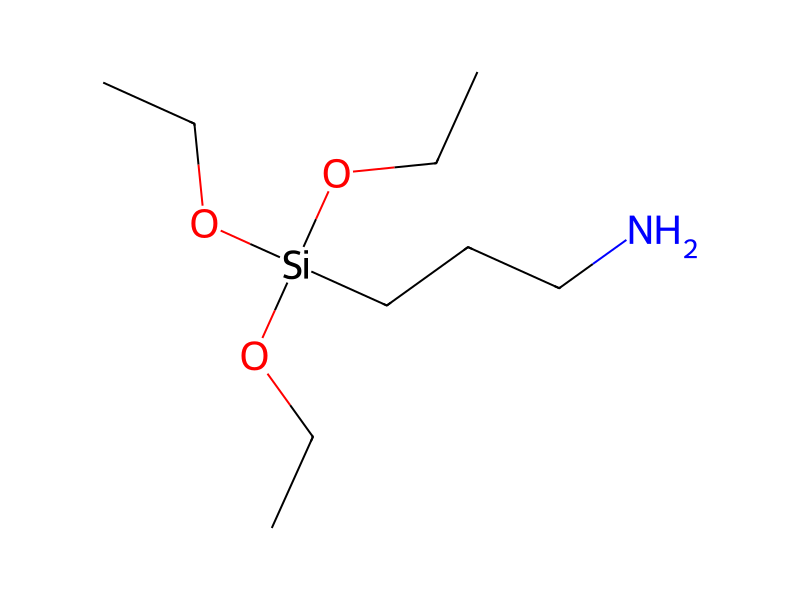
Product 1

Reagents, catalysts & solvents 1

Conditions
- Temperature
- -10 °C
Procedure
3-Aminopropyltriethoxysilane (442 g.), light petroleum (b.p. 30°-40°, 1600 ml) and anhydrous triethylamine (255 g.) were placed under dry nitrogen in a three-necked flask equipped with a stirrer and dropping funnel. The mixture was cooled to -10° C. and a solution of redistilled ethyl chloroformate (217 g.) in light petroleum (b.p. 30°-40° C., 600 ml) was added dropwise over 2 h. The mixture was allowed to warm to ambient temperature and left overnight. The mixture was then rapidly filtered and the solid washed with light petroleum (2 × 300 ml). The combined filtrate was then concentrated and fractionally distilled to give ethyl-N-(3-triethoxysilylpropyl)carbamate (517 g.), b.p. 125°-135° C./0.09 mm.
Workup
- customequipped with a stirrer
- temperatureto warm to ambient temperature
- filtrationThe mixture was then rapidly filtered
- washthe solid washed with light petroleum (2 × 300 ml)
- concentrationThe combined filtrate was then concentrated
- distillationfractionally distilled
Sources & evidence
- ORD record
- ord-f7f04da2f3a74357b71315625320ba6a
- Source dataset
- uspto-grants-1978_10
- Patent number
- US04118367
Reaction notes
Loading…