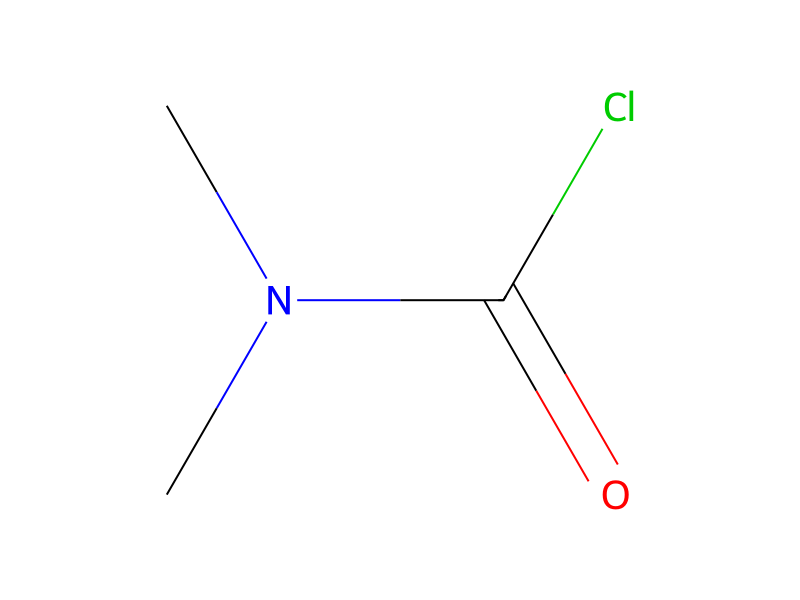
Dimethylcarbamoyl Chloride → 5-(5-Chloro-2-methoxyphenyl)-3-ethoxycarbonyloxazolidine-2,4-dione
Reaction equation

Cl[C:2]([O:4][CH2:5][CH3:6])=[O:3].CN(C)C(Cl)=O.[Cl:13][C:14]1[CH:15]=[CH:16][C:17]([O:27][CH3:28])=[C:18]([CH:20]2[O:24][C:23](=[O:25])[NH:22][C:21]2=[O:26])[CH:19]=1.[Na].ClC1C=CC(OC)=C(C2OC(=O)N(C(=O)N(C)C)C2=O)C=1>>[Cl:13][C:14]1[CH:15]=[CH:16][C:17]([O:27][CH3:28])=[C:18]([CH:20]2[O:24][C:23](=[O:25])[N:22]([C:2]([O:4][CH2:5][CH3:6])=[O:3])[C:21]2=[O:26])[CH:19]=1Participants
5



Procedure
By the same method, but replacing ethyl chloroformate with an equivalent amount of dimethylcarbamoyl chloride, sodium 5-(5-chloro-2-methoxyphenyl)oxazolidine-2,4-dione is converted to 5-(5-chloro-2-methoxyphenyl)-3-dimethylcarbamoyloxazoldine-2,4-dione.
Sources & evidence
- ORD record
- ord-32edfed623464cabaa8f5a29a02016f1
- Source dataset
- uspto-grants-1983_01
- Patent number
- US04367234
Reaction notes
Loading…