Hydrogen Bromide → 4-Nitrobenzoic Acid
Reaction equation

[N+:1]([C:4]1[CH:9]=[CH:8][CH:7]=[CH:6][C:5]=1C)([O-:3])=[O:2].[N+](C1C=CC(C)=CC=1)([O-])=O.Br.[N+](C1C=CC=CC=1[C:27]([OH:29])=[O:28])([O-])=O>C([O-])(=O)C.[Co+2].C([O-])(=O)C.C([O-])(=O)C.[Mn+2].C([O-])(=O)C.[Ti].C(O)(=O)C>[N+:1]([C:4]1[CH:5]=[CH:6][C:7]([C:27]([OH:29])=[O:28])=[CH:8][CH:9]=1)([O-:3])=[O:2]Participants
Reactant 4



Product 1

Reagents, catalysts & solvents 4



Procedure
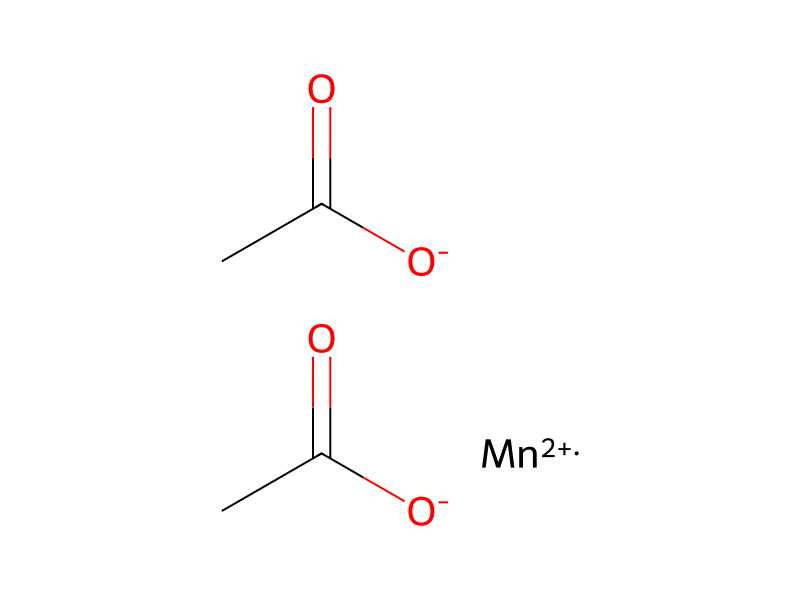
In a modified procedure of Example VI, ortho-nitrotoluene (35 g), para-nitrotoluene (7 g), acetic acid (300 g), cobalt (II) acetate (1 g), manganese (II) acetate (1 g), zirconium (IV) diacetate oxide (0.125 g), and 48% hydrobromic acid (1.4 g) were charged into a one liter titanium autoclave. The para-nitrotoluene and acetic acid were added in a semi-continuous procedure, with an initial charge of 7 g and 300 g, respectively. The oxidation was initiated by introducing air into the reactor at an initial temperature of 295° F. and an initial pressure of 250 psig. During the oxidation, a solution consisting of 28 g para-nitrotoluene, to give a 1:1 gram ratio and 1:1 mol ratio of o-nitrotoluene and para-nitrotoluene, and 120 g of acetic acid were added semi-continuously. LC analysis of the slurry indicated that ortho-nitrobenzoic acid was formed in 69.1 mol % yield, while p-nitrobenzoic acid was produced in 82.7 mol % yield. Ortho-nitrotoluene (24.1 mol %), para-nitrotoluene (8.1 mol %), para-nitrobenzaldehyde (1.8 mol %), and para-nitrobenzyl acetate (0.8 mol %) were also detected. Details are in Table V.
Workup
- additionwith an initial charge of 7 g and 300 g
- additionby introducing air into the reactor at an initial temperature of 295° F.
- customto give a 1
- customwas formed in 69.1 mol %
Sources & evidence
- ORD record
- ord-43f8771df29442efaa21207d045b8dd3
- Source dataset
- uspto-grants-1990_03
- Patent number
- US04906771
Reaction notes
Loading…