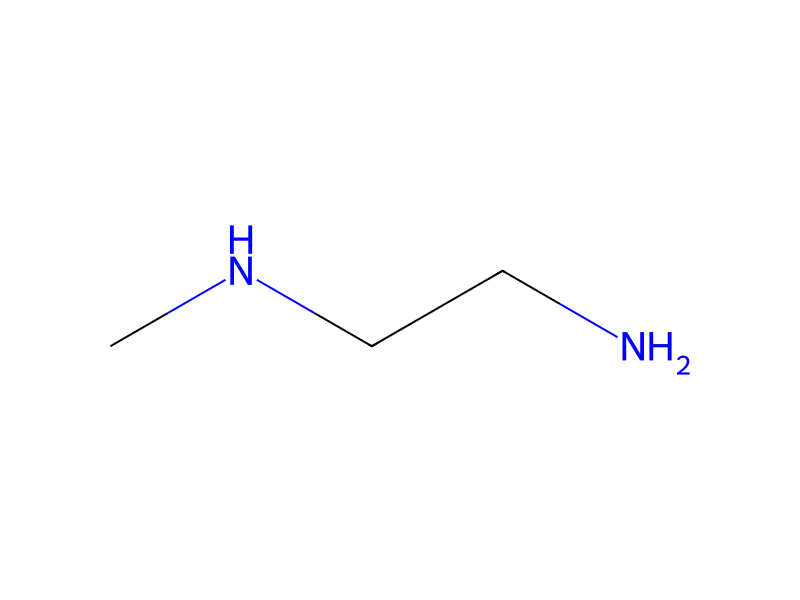
N-Methylethylenediamine → 3,5-diamino-6-chloro-N-(2-methylaminoethyl)pyrazine-2-carboxamide
Reaction equation

[NH2:1][C:2]1[C:3]([C:10]([O:12]C)=O)=[N:4][C:5]([Cl:9])=[C:6]([NH2:8])[N:7]=1.[CH3:14][NH:15][CH2:16][CH2:17][NH2:18]>O1CCCC1>[NH2:1][C:2]1[C:3]([C:10]([NH:18][CH2:17][CH2:16][NH:15][CH3:14])=[O:12])=[N:4][C:5]([Cl:9])=[C:6]([NH2:8])[N:7]=1Participants
4



Procedure
A mixture of 20 g (99.0 mmol) of methyl 3,5-diamino-6-chloropyrazine-2-carboxylate (see U.S. Pat. No. 4,029,816 for an example of how to obtain this material) and 17 g (230.0 mmol) of N-methylethylenediamine was heated at reflux under an inert atmosphere for 30 hours. The rection mixture was cooled to ambient temperature and the solid was dissolved in 100 ml of tetrahydrofuran. The solution was filtered and evaporated. The residue was crystallized from 2-propanol. There was obtained 15.0 g (61.2 mmol, 61%) of 3,5-diamino-6-chloro-N-(2-methylaminoethyl)pyrazine-2-carboxamide; mp 142.5°-143° C.
Workup
- temperaturewas heated
- temperatureat reflux under an inert atmosphere for 30 hours
- filtrationThe solution was filtered
- customevaporated
- customThe residue was crystallized from 2-propanol
Sources & evidence
- ORD record
- ord-78c67c5d94084f14ada9ce2cbb35759a
- Source dataset
- uspto-grants-1990_03
- Patent number
- US04910202
Reaction notes
Loading…