1,3-Dichloroacetone → 4-(Chloromethyl)-2-(4-fluorophenyl)-1,3-oxazole
Reaction equation
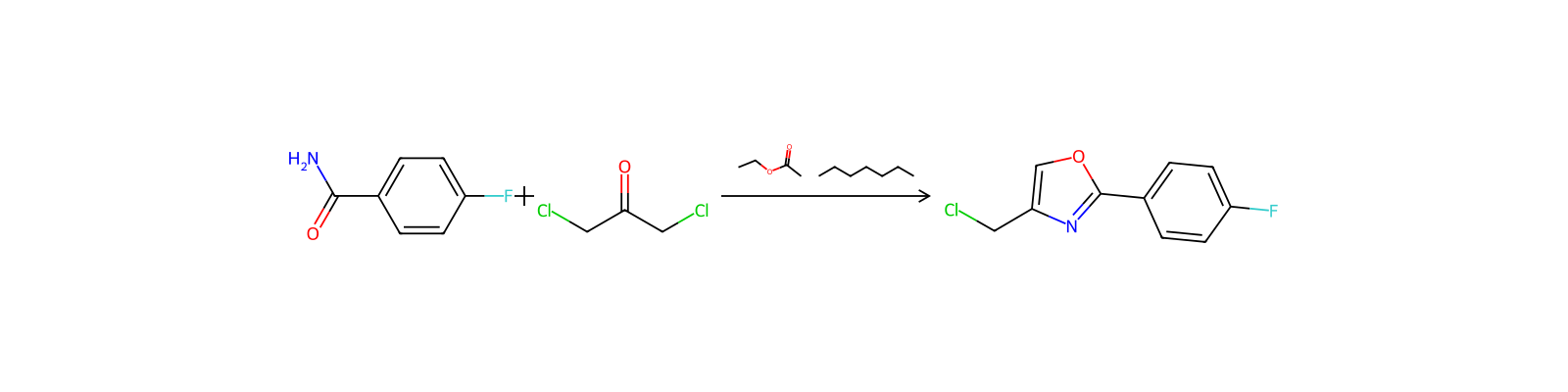
[F:1][C:2]1[CH:10]=[CH:9][C:5]([C:6]([NH2:8])=[O:7])=[CH:4][CH:3]=1.[Cl:11][CH2:12][C:13]([CH2:15]Cl)=O>C(OCC)(=O)C.CCCCCCC>[Cl:11][CH2:12][C:13]1[N:8]=[C:6]([C:5]2[CH:9]=[CH:10][C:2]([F:1])=[CH:3][CH:4]=2)[O:7][CH:15]=1Participants
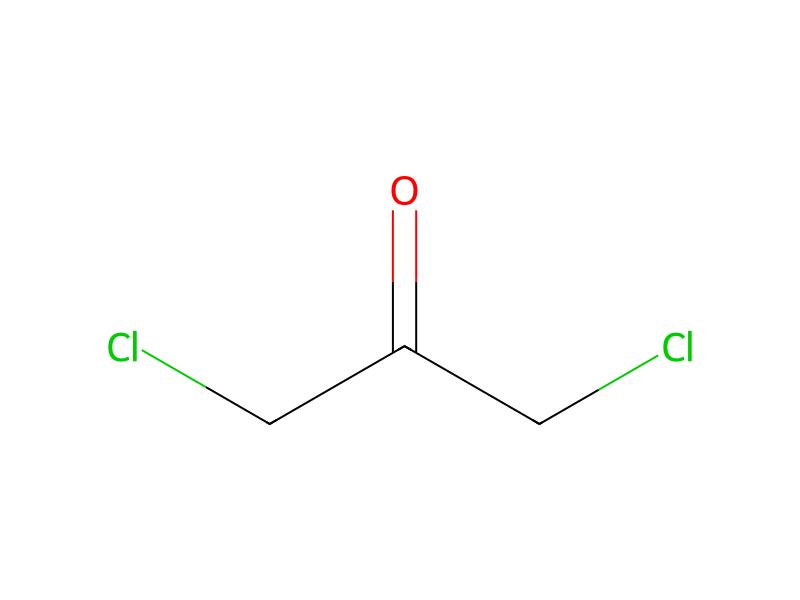
Reactant 2

Product 1

Reagents, catalysts & solvents 2


Procedure
At 120° C., 31 g (123 mmol) of p-fluorobenzamide and 33 g (123 mmol) of 1,3-dichloroacetone were stirred in the absence of a solvent for 2 hours. After cooling to room temperature, the product was dissolved in 250 ml of ethyl acetate. This solution was diluted with 400 ml of n-heptane and washed 3 times with saturated NaCl solution. The organic phase was filtered through 250 ml of silica gel, and the filter pad was then washed with 200 ml of n-heptane/ethyl acetate (4:1). The solvent was distilled off, giving 4-chloromethyl-2-(4-fluorophenyl)oxazole 1 as crude product. This was dissolved in 650 ml of acetone, and 90 g of NaI were then added. The mixture was then heated at reflux for 16 hours, most of the solvent was then removed and the solid residue was suspended in 200 ml of n-heptane/ethyl acetate (1:1) and filtered through 200 ml of silica gel. The precipitate was washed with 500 ml of n-heptane/ethyl acetate (1:1), and the organic phase was concentrated. On concentration, the iodide 2 began to crystallize as white crystals. TLC n-heptane/ethyl acetate (6:1) Rf 0.4 for 2 and Rf=0.35 for 1. C10H7FINO (303.08) MS(ESI): 304 (M+H+).
Workup
- washwashed 3 times with saturated NaCl solution
- filtrationThe organic phase was filtered through 250 ml of silica gel
- washthe filter pad was then washed with 200 ml of n-heptane/ethyl acetate (4:1)
- distillationThe solvent was distilled off
Sources & evidence
- ORD record
- ord-eddf333a07644d51895db3050f78c0a1
- Source dataset
- uspto-grants-2003_09
- Patent number
- US06624185B2
Reaction notes
Loading…