Ethyl phosphorochloridite → Diethyl 2-[di(1-naphthyl)phosphino]phenylphosphonite
Reaktionsgleichung

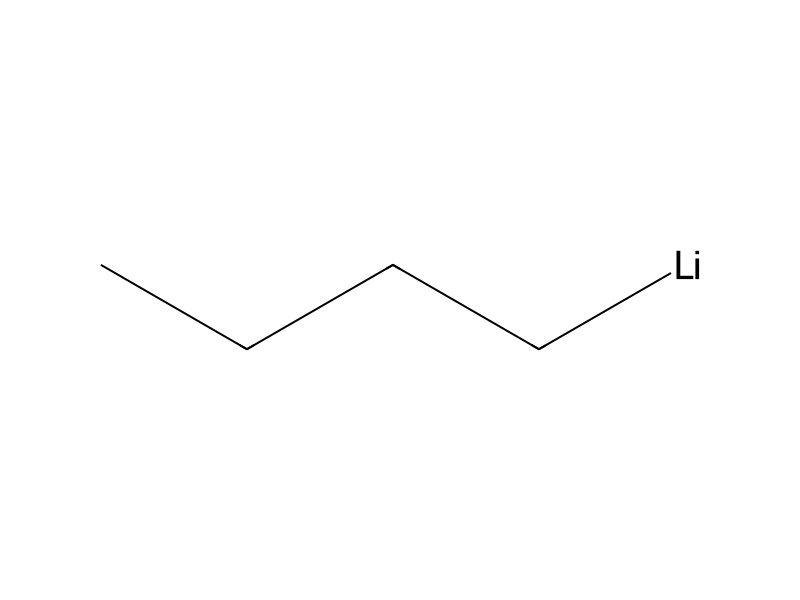
Br[C:2]1[CH:7]=[CH:6][CH:5]=[CH:4][C:3]=1[P:8]([C:19]1[C:28]2[C:23](=[CH:24][CH:25]=[CH:26][CH:27]=2)[CH:22]=[CH:21][CH:20]=1)[C:9]1[C:18]2[C:13](=[CH:14][CH:15]=[CH:16][CH:17]=2)[CH:12]=[CH:11][CH:10]=1.[P:29](Cl)([O:33][CH2:34][CH3:35])[O:30][CH2:31][CH3:32].C([Li])CCC>>[C:9]1([P:8]([C:19]2[C:28]3[C:23](=[CH:24][CH:25]=[CH:26][CH:27]=3)[CH:22]=[CH:21][CH:20]=2)[C:3]2[CH:4]=[CH:5][CH:6]=[CH:7][C:2]=2[P:29]([O:33][CH2:34][CH3:35])[O:30][CH2:31][CH3:32])[C:18]2[C:13](=[CH:14][CH:15]=[CH:16][CH:17]=2)[CH:12]=[CH:11][CH:10]=1Komponenten



Versuchsvorschrift
For example, 2-bromophenol (4) is reacted with trifluoromethanesulfonic anhydride to form 2-(trifluoromethanesulfonyl)oxy-bromobenzene (5), which is then reacted with di(1-naphthyl)phosphine in the presence of a palladium complex catalyst to obtain (2-bromophenyl)[di(1-naphthyl)]phosphine (6). Next, the compound (6) is reacted with diethyl chlorophosphite in the presence of n-butyllithium to obtain diethyl 2-[di(1-naphthyl)phosphino]phenylphosphonite (7). Then, the compound (7) is reduced with lithium aluminum hydride in the presence of chlorotrimethylsilane to form [2-[di(1-naphthyl)phosphino]phenylphosphine (8). Thereafter, in the presence of n-butyllithium, the compound is reacted with dimesylate of (2R,5R)-2,5-hexanediol producible, for example, according to the method described in a literature (Tetrahedron: Asymmetry, 1991, 2, 569), whereby the aimed (S,S)-Me-UCAP-(1-Nap) (3) can be produced in a high efficiency.
Quellen und Nachweise
- ORD-Eintrag
- ord-8d84efb14c304e389dcbe1ceaae42046
- Quelldatensatz
- uspto-grants-2003_09
- Patentnummer
- US06624320B2
Notizen zur Reaktion
Wird geladen…