1,1-Dichloroethane → HCID 11429521, compound
Reaction equation

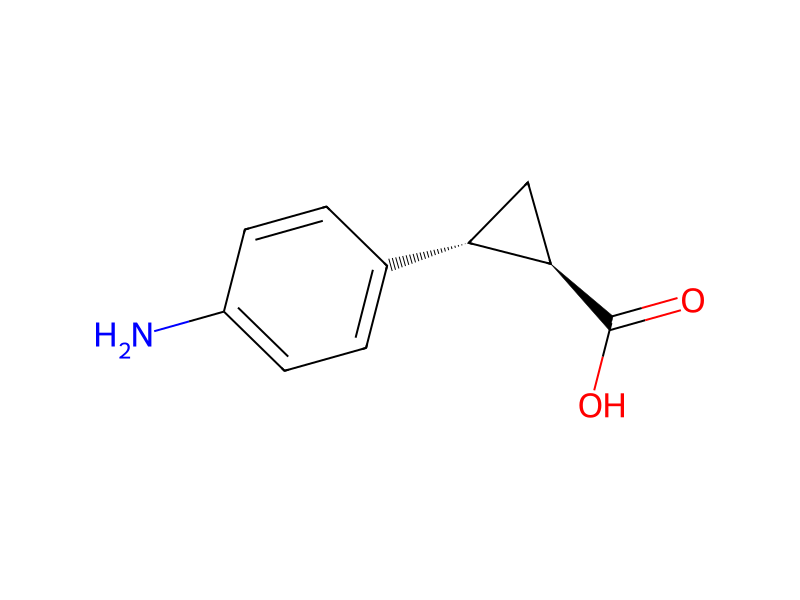
[NH2:1][C:2]1[CH:7]=[CH:6][C:5]([C@@H:8]2[CH2:10][C@H:9]2[C:11]([OH:13])=[O:12])=[CH:4][CH:3]=1.ClC(Cl)C.[F:18][C:19]([F:34])([F:33])[C:20]1[CH:25]=[CH:24][C:23]([C:26]2[CH:27]=[C:28]([CH:31]=O)[O:29][CH:30]=2)=[CH:22][CH:21]=1.C(O[BH-](OC(=O)C)OC(=O)C)(=O)C.[Na+]>>[F:34][C:19]([F:18])([F:33])[C:20]1[CH:21]=[CH:22][C:23]([C:26]2[CH:27]=[C:28]([CH2:31][NH:1][C:2]3[CH:3]=[CH:4][C:5]([C@@H:8]4[CH2:10][C@H:9]4[C:11]([OH:13])=[O:12])=[CH:6][CH:7]=3)[O:29][CH:30]=2)=[CH:24][CH:25]=1Participants




Procedure
A mixture of racemic-(trans)-2-(4-aminophenyl)cyclopropanecarboxylic acid (I-1) (0.060 g, 0.339 mmols) and dichloroethane was heated slightly and allowed to cool before addition of 4-[4-(trifluoromethyl)phenyl]-2-furancarbaldehyde (0.075 g, 0.312 mmols). The mixture was stirred for 7 h, followed by addition of sodium triacetoxyborohydride (0.104 g, 0.491 mmols). After 12 h, the mixture was partitioned between water and CH2Cl2 (10 mL each). The aqueous phase was extracted with CH2Cl2 (1×10 mL). The combined organics were dried with MgSO4 and concentrated to give the title compound as a yellow solid (0.139 g, quant). 1H NMR (400 MHz, DMSO-d6): δ 12.01 (s, 1H), 8.23 (s, 1H), 7.75 (d, J=8.24 Hz, 2H), 7.68 (d, J=8.42 Hz, 2H), 6.85 (d, J=8.42 Hz, 2H), 6.81 (s, 1H), 6.56 (d, J=8.61 Hz, 2H), 6.05 (t, J=5.95 Hz, 1H), 4.22 (d, H=5.86 Hz, 2H), 2.18 (m, 1H), 1.58 (m, 1H), 1.27 (m, 1H), 1.16 (m, 1H). APCI m/z 399.93 (MH−).
Workup
- temperaturewas heated slightly
- waitAfter 12 h
- customthe mixture was partitioned between water and CH2Cl2 (10 mL each)
- extractionThe aqueous phase was extracted with CH2Cl2 (1×10 mL)
- dry with materialThe combined organics were dried with MgSO4
- concentrationconcentrated
Sources & evidence
- ORD record
- ord-6cbb8541e4d84bbdb34b273d01515ab3
- Source dataset
- uspto-grants-2010_11
- Patent number
- US07834013B2
Reaction notes
Loading…