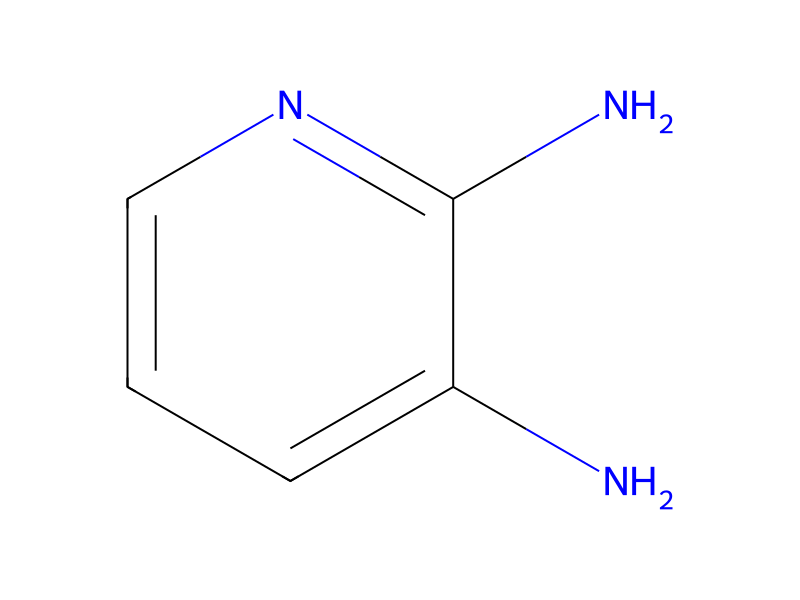
2,3-Diaminopyridine → HCID 19080185, compound
Reaction equation

[NH2:1][C:2]1[C:7]([NH2:8])=[CH:6][CH:5]=[CH:4][N:3]=1.[Cl:9][C:10]1[CH:11]=[C:12]([S:16](Cl)(=[O:18])=[O:17])[CH:13]=[CH:14][CH:15]=1>O1CCCC1.O>[NH2:1][C:2]1[C:7]([NH:8][S:16]([C:12]2[CH:13]=[CH:14][CH:15]=[C:10]([Cl:9])[CH:11]=2)(=[O:18])=[O:17])=[CH:6][CH:5]=[CH:4][N:3]=1Participants
Reactant 2

Product 1

Reagents, catalysts & solvents 2


Procedure
1.97 g (18 mmol) of 2,3-diaminopyridine was dissolved in a mixed solution of tetrahydrofuran and water, and a tetrahydrofuran solution containing 1.90 g (9.0 mmol) of 3-chlorobenzenesulfonyl chloride was added thereto. After stirring at room temperature overnight, the mixture was concentrated, and water and dichloromethane were added to the residue. The organic layer was separated, and the wall of the reactor was rubbed. The resulting crystals were collected by filtration, to give 1.41 g of N-(2-amino-3-pyridiny)-3-chlorobenzenesulfonamide. 530 mg (1.87 mmol) of the crystals was dissolved in methanol and 367 mg (1.87 mmol) of an aqueous 40% chloroacetoaldehyde solution was added thereto. After heating under reflux for 4 hours, the mixture was concentrated to dryness. A small amount of methanol was added to the residue and the crystals were collected by filtration, to give 373 mg of the title compound.
Workup
- additionwas added
- concentrationthe mixture was concentrated
- additionwater and dichloromethane were added to the residue
- customThe organic layer was separated
- filtrationThe resulting crystals were collected by filtration
Sources & evidence
- ORD record
- ord-6a46422ba06b44bfa7a3beee0844080b
- Source dataset
- uspto-grants-2010_11
- Patent number
- US07834049B2
Reaction notes
Loading…