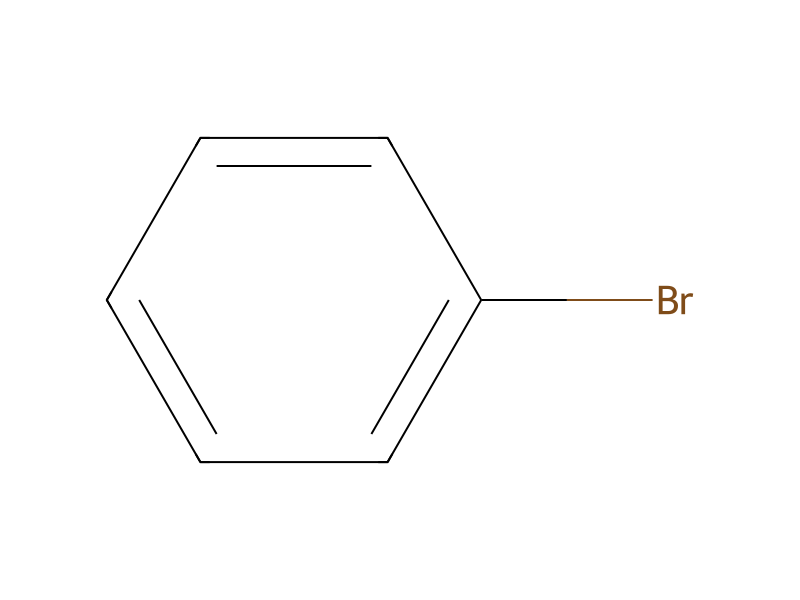
Bromobenzene → HCID 68505148, compound
Reaction equation

[OH:1][C@H:2]1[CH2:6][CH2:5][NH:4][C:3]1=[O:7].C(=O)([O-])[O-].[Cs+].[Cs+].Br[C:15]1[CH:20]=[CH:19][CH:18]=[CH:17][CH:16]=1.O1CCOCC1>ClCCl>[OH:1][C@H:2]1[CH2:6][CH2:5][N:4]([C:15]2[CH:20]=[CH:19][CH:18]=[CH:17][CH:16]=2)[C:3]1=[O:7]Participants
6
Reactant 4



Product 1

Reagents, catalysts & solvents 1

Procedure
A Schlenk flask is initially charged with 0.123 g of 3(S)-hydroxy-pyrrolidin-2-one, 0.453 g of caesium carbonate, 0.032 g of dipalladiumtris(dibenzylidenacetone)-chloroform complex and 0.052 g of 9,9-dimethyl-4,5-bis(diphenylphosphine)xanthane under argon. 0.110 ml of bromobenzene and 2 ml dioxane are added and the reaction mixture is heated to reflux over 14 hours. The reaction mixture is subsequently cooled to room temperature, diluted with dichloromethane and filtered through Hyflo, and the filtrate is concentrated by evaporation. The title compound is obtained as a beige solid from the residue by means of flash chromatography (SiO2 60F). Rf=0.24 (4:1 EtOAc-heptane); Rt=2.50.
Workup
- temperaturethe reaction mixture is heated
- temperatureto reflux over 14 hours
- filtrationfiltered through Hyflo
- concentrationthe filtrate is concentrated by evaporation
Sources & evidence
- ORD record
- ord-9f5fc15d8d59410c9117a235ce4cd8e5
- Source dataset
- uspto-grants-2010_11
- Patent number
- US07842688B2
Reaction notes
Loading…