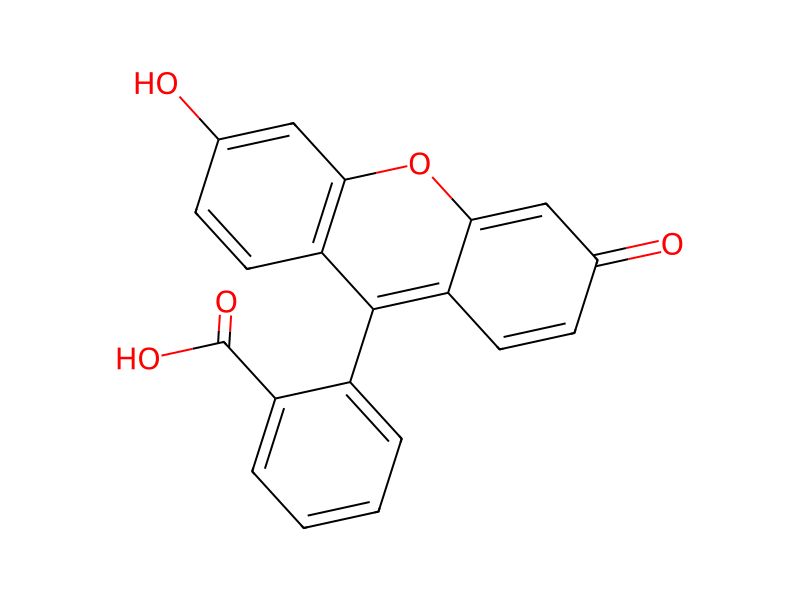
Eosin → 2-(6-Hydroxy-3-oxo-3H-xanthen-9-yl)benzoic acid
Reaction equation

[CH:1]1[CH:6]=[C:5]([C:7]2[C:21]3[C:16](=[C:17](Br)[C:18]([O-:23])=[C:19](Br)[CH:20]=3)[O:15][C:14]3[C:8]=2[CH:9]=[C:10](Br)[C:11]([C:13]=3Br)=[O:12])[C:4]([C:27]([O-:29])=[O:28])=[CH:3][CH:2]=1.[Na+].[Na+].[Na][Na].CC1C(Br)=CC2C(C3C=CC=CC=3C(O)=O)=C3C(=C(Br)C(C(Br)=C3)=O)OC=2C=1Br>O>[CH:1]1[CH:2]=[CH:3][C:4]([C:27]([OH:29])=[O:28])=[C:5]([C:7]2[C:8]3[CH:9]=[CH:10][C:11]([OH:12])=[CH:13][C:14]=3[O:15][C:16]3[C:21]=2[CH:20]=[CH:19][C:18]([CH:17]=3)=[O:23])[CH:6]=1Participants
5
Reactant 3


Product 1
Reagents, catalysts & solvents 1

Procedure
With total consumption of the fluorescein, the bromination reaction leads to the formation of a single product, tetrabromofluorescein (4Br—F), the disodium salt of which is commercially known as Eosin Y. The final reaction mixture is diluted in water and the product is extracted from the mixture with ethyl acetate.
Workup
- customWith total consumption of the fluorescein
- customthe bromination reaction
- customThe final reaction mixture
- extractionthe product is extracted from the mixture with ethyl acetate
Sources & evidence
- ORD record
- ord-056a597e74014b6f9e496c2103f8b8aa
- Source dataset
- uspto-grants-2010_11
- Patent number
- US07842826B2
Reaction notes
Loading…