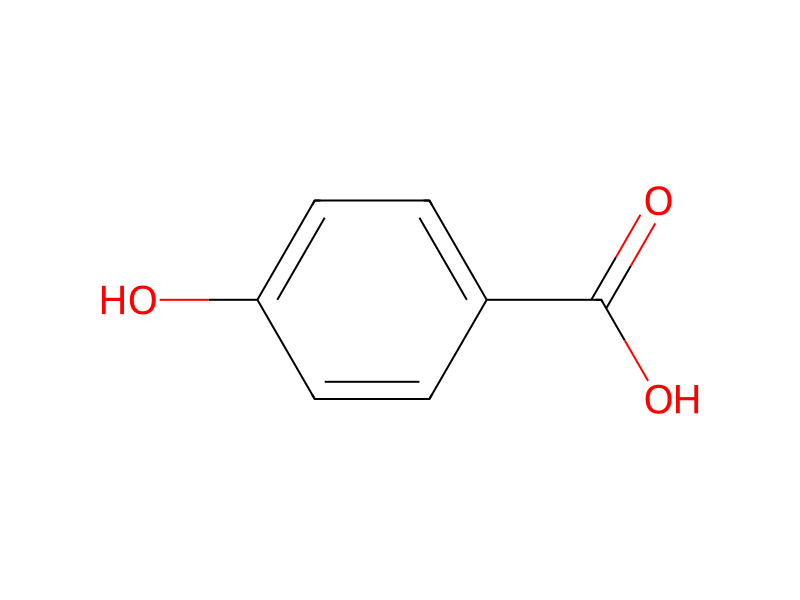
4-Hydroxybenzoic Acid → 4-Hydroxy-3,5-diisopropylbenzoic acid
Reaction equation

[CH:1]([C:4]1[CH:9]=[CH:8][CH:7]=[C:6]([CH:10]([CH3:12])[CH3:11])[C:5]=1[OH:13])([CH3:3])[CH3:2].OC1C=CC([C:19]([OH:21])=[O:20])=CC=1.[OH-].[Na+]>>[OH:13][C:5]1[C:4]([CH:1]([CH3:3])[CH3:2])=[CH:9][C:8]([C:19]([OH:21])=[O:20])=[CH:7][C:6]=1[CH:10]([CH3:12])[CH3:11]Participants



Procedure
The process for the preparation of highly pure 2,6-diisopropyl phenol (Formula I), comprises reacting p-hydroxy benzoic acid (Formula II) with an alkylating agent in presence of aq. mineral acid at a temperature in the range of 60-65° C. followed by basification with sodium hydroxide to yield crude 4-hydroxy-3,5-diisopropylbenzoic acid (Formula III) including ether impurity 3,5-di(propan-2-yl)-4-(propan-2-yloxy)benzoic acid of Formula V, dimer impurity, 4,4′-oxydibenzoic acid of Formula IV, and the monoalkylated impurity 4-hydroxy-3-(propan-2-yl)benzoic acid of Formula VI and subsequently (a) washing with toluene at basic pH to remove the ether impurity 3,5-di(propan-2-yl)-4-(propan-2-yloxy)benzoic acid of Formula V; (b) washing with hot water to remove dimer impurity 4,4′-oxydibenzoic acid of Formula IV; (c) washing with methanol-water mixture, to remove monoalkylated impurity 4-hydroxy-3-(propan-2-yl)benzoic acid of Formula VI, followed by decarboxylation of 4-hydroxy-3,5-diisopropylbenzoic acid (Formula III), free from impurities of Formula IV, V and VI, in presence of high boiling solvent and a catalyst at high temperature to yield 2,6-diisopropyl phenol having purity of 99.9% by HPLC. 2,6-diisopropyl phenol thus obtained is substantially free of ether impurity 1,3-di(propan-2-yl)-2-(propan-2-yloxy)benzene of Formula VII and monoalkylated phenol impurity 2-(propan-2-yl) phenol of Formula VIII.
Workup
- customin the range of 60-65° C.
Sources & evidence
- ORD record
- ord-a5a06de00e1748159ab4882fbc45e85c
- Source dataset
- uspto-grants-2014_03
- Patent number
- US08664452B2
Reaction notes
Loading…