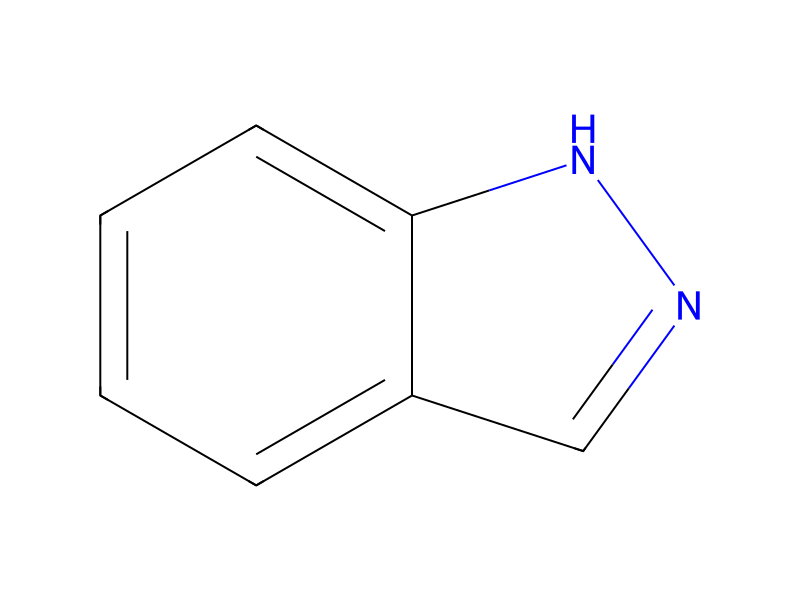
1H-Indazole → HCID 57691801, compound
Reaction equation

Br[CH2:2][CH2:3][C:4]#[C:5][Si:6]([CH3:9])([CH3:8])[CH3:7].[NH:10]1[C:18]2[C:13](=[CH:14][CH:15]=[CH:16][CH:17]=2)[CH:12]=[N:11]1.C([O-])([O-])=O.[K+].[K+].C[Si](C)(C)C#CCCN1C2C(=CC=CC=2)C=N1>CC(C)=O.O>[CH3:7][Si:6]([CH3:9])([CH3:8])[C:5]#[C:4][CH2:3][CH2:2][N:11]1[CH:12]=[C:13]2[C:18]([CH:17]=[CH:16][CH:15]=[CH:14]2)=[N:10]1Participants
7





Conditions
- Temperature
- 150 °C
Procedure
A suspension of (4-bromo-but-1-ynyl)-trimethyl-silane (374 mg, 1.83 mmol), indazole (200 mg, 1.69 mmol) and K2CO3 (459 mg, 3.32 mmol) in acetone (2 mL) was heated at 150° C. for 900 s in a microwave. After the addition of water, acetone was evaporated. The aqueous phase was extracted with DCM. The organic phase was washed with brine, dried over MgSO4, filtered and evaporated to yield 250 mg (1.03 mmol, 62%) of 2-(4-trimethylsilanyl-but-3-ynyl)-2H-indazole and 1-(4-trimethylsilanyl-but-3-ynyl)-1H-indazole.
Workup
- customwas evaporated
- extractionThe aqueous phase was extracted with DCM
- washThe organic phase was washed with brine
- dry with materialdried over MgSO4
- filtrationfiltered
- customevaporated
Sources & evidence
- ORD record
- ord-088b55f05e2e4eed95a7caa374fa5b2d
- Source dataset
- uspto-grants-2014_03
- Patent number
- US08674106B2
Reaction notes
Loading…