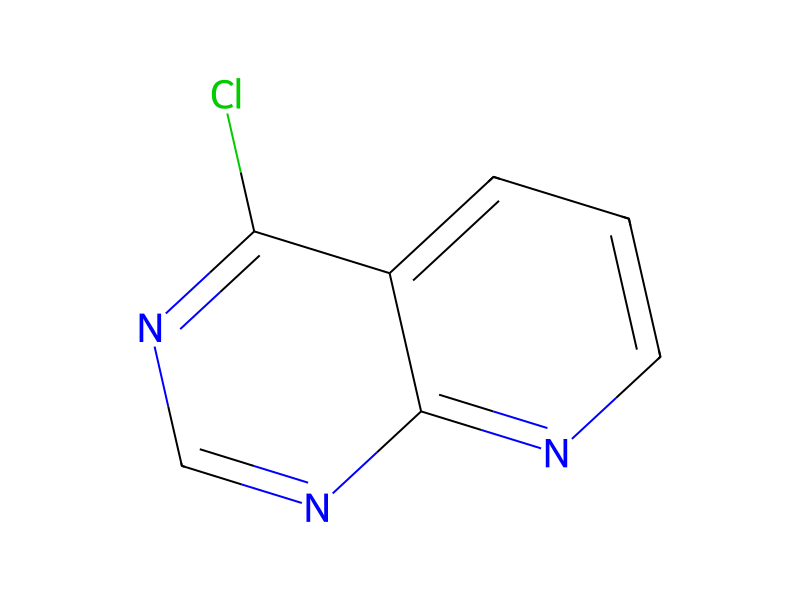
Phosphorus oxychloride → 4-Chloropyrido[2,3-d]pyrimidine
Reaction equation

O[C:2]1[C:3]2[CH:11]=[CH:10][CH:9]=[N:8][C:4]=2[N:5]=[CH:6][N:7]=1.O=P(Cl)(Cl)[Cl:14]>>[Cl:14][C:2]1[C:3]2[CH:11]=[CH:10][CH:9]=[N:8][C:4]=2[N:5]=[CH:6][N:7]=1Participants
3


Procedure
The solution of 4-hydroxypyrido[2,3-d]pyrimidine (2.00 g, 13.6 mmol) in POCl3 (40 mL) was refluxed for 2 hours. After cooling, the excess POCl3 was removed under vacuum. The residue was quenched with saturated NaHCO3 and extracted with ethyl acetate (3×100 mL). The organic phase was dried and concentrated. The residue was subject to column chromatography, eluted by hexane/ethyl acetate (1:1) to give 4-chloropyrido[2,3-d]pyrimidine (0.72 g, 32%). 1H NMR (CDCl3, 400 MHz) δ 9.35 (m, 1H), 9.30 (s, 1H), 8.66 (m, 1H), 7.73 (m, 1H). MS (APCI+) [M+H]+166.
Workup
- temperatureAfter cooling
- customthe excess POCl3 was removed under vacuum
- customThe residue was quenched with saturated NaHCO3
- extractionextracted with ethyl acetate (3×100 mL)
- customThe organic phase was dried
- concentrationconcentrated
- washeluted by hexane/ethyl acetate (1:1)
Sources & evidence
- ORD record
- ord-7c4902a3be2e4fa4ad671e0eaf72a667
- Source dataset
- uspto-grants-2014_03
- Patent number
- US08680114B2
Reaction notes
Loading…